×

New strains of norovirus affect thousands of Australians

Scientists from the University of New South Wales have identified three new strains of highly contagious norovirus responsible for an outbreak of gastroenteritis that affected thousands of Australians during winter.

Scores of outbreaks of nausea, vomiting and diarrhoea have occurred in Sydney, the Hunter region and the ACT, mainly in closed settings including aged care facilities, hospitals, childcare centres and cruise ships, with more cases expected.

On Saturday a 79-year-old woman died from what her family said was an outbreak of gastroenteritis on a cruise ship off the coast of Queensland, according to Fairfax Media reports. P&O has denied there was a gastro outbreak.

Professor Peter White and his team at the UNSW Faculty of Science discovered a new strain of norovirus in 2012, which caused a worldwide pandemic of gastro, including major outbreaks in Australia.

The strain, named Sydney 2012, was responsible for a large number of cases until this year.

“Now that Sydney 2012 has declined, three new strains of norovirus have emerged as a new major health concern,” Professor White said.

“They are responsible for a big increase in the number of gastro cases in Australia in the past two months, and this new spate of infection is likely to continue to cause a wave of sick leave that will affect businesses and schools already reeling from the effects of the current influenza epidemic.”

Each year, norovirus infects about two million Australians and kills about 220,000 people worldwide. The nausea, vomiting and diarrhoea usually last for two to three days.

Latest news

Aleppo’s dying children and shattered health system: is there light at the end of the tunnel?

Being a doctor can be risky business, some times more than others.

During my dozen medical missions to Syria, I had to crawl under a border fence, jump over walls, walk in the mountains at night for hours without any light, pass through the sniper alley in Aleppo, negotiate with smugglers and work in bombed, underground hospitals.

The Syrian crisis is now in its fifth year. The country’s health services are under unprecedented strain due to the protracted war, deliberate targeting of health staff and infrastructure by the Syrian regime and Russian forces, the exodus of physicians and nurses, shortages of medical supplies and medications and the disruption of medical education and training.

Syria’s largest city, Aleppo, has 85,000 children, including around 20,000 below the age of two. Dozens are injured every week, just like five-year-old Omran Daqneesh whose pictures have shocked the world. Many have far worse injuries and will not survive.

I took care of some of these unlucky children, such as Ahmad Hijazi, also five years old. He was hit by one of Assad’s barrel bombs. These are containers the size of barrels, stuffed with TNT and metal shrapnel, which the Syrian regime throws from helicopters onto urban areas such as hospitals, civilian neighbourhoods, fruit markets and schools.

Hijazi had shrapnel lodged in his spinal cord and was paralysed from his neck down. When I saw him, he was breathing with great difficulty, so we put a breathing tube in his mouth and put him on life support. The day after I left, he had a cardiac arrest and died.

Around half-a-million people have been killed in the conflict. Half of the population has been displaced. There seems to be no light at the end of the tunnel.

Medical neutrality is a principle under international humanitarian law that ensures protection of medical personnel, patients, facilities and transport from attack or interference. It also underpins unhindered access to medical care and treatment; humane treatment of all civilians; and non-discriminatory treatment of the injured and sick.

Systematic attacks on health care, mostly by the Syrian government and recently Russia, are violations of medical neutrality and therefore war crimes under the Geneva Conventions.

A health system in ruins

Before the onset of fighting, Syria’s health care system was comparable with that of other middle-income countries, such as Iran. By 2015, all sectors of the country’s health infrastructure had disintegrated.

Within only a few years, the life expectancy of resident Syrians has declined by 20 years; from 76 in 2010 to 56 by the end of 2014. This isn’t all due to the direct effects of war.

Many more Syrians have died prematurely from infections and chronic disease than from the fighting – this includes diseases such as pneumonia, hepatitis, tuberculosis and diarrhoeal infections, as well as heart disease, kidney disease, diabetes, cancer and chronic obstructive pulmonary disease.

Hospitals and clinics have been destroyed. Eight out of the ten hospitals in Eastern Aleppo are partially functional or out of service as a result of targeted attacks. From March 2011 to the end of May 2016, at least 738 Syrian doctors, nurses and medical aides died in 373 attacks on medical facilities.

Aleppo's dying children and shattered health system: is there light at the end of the tunnel? - Featured Image

Pictures of Omran Daqneesh have shocked the world, but doctors in Aleppo see dozens of desperate children like him every week.
ALEPPO MEDIA CENTER, @AleppoAMC / HANDOUT

The working conditions of Aleppo’s remaining doctors are unsustainable. An estimated 35 doctors are left in Eastern Aleppo which, with a population of approximately 300,000, means there is one doctor for every 8,570 people. There is not a single critical-care doctor – my own speciality – despite the abundance of critically ill patients.

Doctors, local administrators and NGOs are struggling in substandard conditions and often use unorthodox methods to do their work. They work in underground makeshift hospitals, hospitals dug into mountains or in natural caves for protection. They perform surgeries without light, proper anaesthesia or sterilisation, transfuse blood without proper matching and have medical students or dentists perform life-saving procedures due to the shortage of specialists.

Much-needed medical supplies are channelled through dangerous routes across the borders of Lebanon, Jordan and Turkey. As physicians, we can’t wait for politicians to fix the crisis.

What needs to be done

Fifteen Aleppo doctors recently penned an open letter to US President Obama, in which they wrote that “there is an attack on a medical facility every 17 hours” by the Russian-backed Syrian air force.

Meanwhile, the charity Syrian American Medical Society reported that July has been the worst month for attacks on health care since the beginning of the conflict. There were 43 attacks on health facilities in the month – more than one a day. By comparison, this number of attacks occurred over six months in 2015, with 47 attacks from January to May.

Charities and other organisations, such as the Syrian American Medical Society, have pioneered solutions to some of the resource gaps. These include portable ultrasounds and other point-of-care diagnostic tools, as well as virtual wards connecting nurses and doctors in besieged areas with specialists in the United States.

Doctors in the US and other Western nations have helped Syrian counterparts make the best of the situation by providing training and helping with technology and treatment. But more needs to be done to support remaining health workers.

International medical organisations should advocate on behalf of their Syrian colleagues and champion an end to violations of international humanitarian law.

Educational opportunities to support Syrian health professionals, including scholarships for medical students, would help with ensuring there are enough staff to rebuild the Syrian health system. More resources should be directed to research the impact of conflicts on health care and the use of technology and other innovative solutions to mitigate harms.

Consensus should be achieved and acted on by the international community on the urgent need to protect civilians from airstrikes and chemical attacks. This is needed to apply pressure on the Syrian government to stop targeting the remaining health care staff and hospitals.

We should share knowledge, skills and technology with all patients, across the world. Although our local patients are a priority, we can also benefit the global community.

The Conversation

Zaher Sahloul, Associate Clinical Professor, University of Illinois at Chicago This article was originally published on The Conversation. Read the original article.

Main photo: kafeinkolik / Shutterstock.com

Other doctorportal blogs

Progress in the care of familial hypercholesterolaemia: 2016

Familial hypercholesterolaemia (FH) is the most common autosomal dominant condition.1 FH reduces the catabolism of low-density lipoprotein cholesterol (LDL-c) and increases rates of premature atherosclerotic cardiovascular disease (CVD). This review focuses on recent advances in the management of FH, and the implications for both primary and secondary care, noting that the majority of individuals with FH remain undiagnosed.2

FH was previously considered to have a prevalence of one in 500 in the general community, including in Australia.3 Recent evidence, however, suggests the prevalence is between one in 200 and one in 350, which equates to over 30 million people estimated to have FH worldwide.4,5 These prevalence figures relate to the general population, and while FH is present in all ethnic groups, communities with gene founder effects and high rates of consanguinity, such as the Afrikaans, Christian Lebanese and Québécois populations, have a higher prevalence of the condition.

Further, the prevalence of homozygous or compound heterozygous FH has been demonstrated to be at least three times more common than previously reported, with a prevalence of about one in 300 000 people in the Netherlands.4 The detection and management of individuals with homozygous FH has been described in a consensus report from the European Atherosclerosis Society.6 Homozygous FH is a very severe disorder, with untreated people often developing severe atherosclerotic CVD before 20 years of age. Such individuals often have LDL-c concentrations > 13 mmol/L and severe cutaneous and tendon xanthomata. While diet and statins are the mainstays of therapy, early intervention (before 8 years of age) with LDL apheresis or novel lipid-lowering medication, such as proprotein convertase subtilisin/kexin type 9 (PCSK9) inhibitors or microsomal triglyceride transfer protein inhibitors, is indicated. Patients with suspected homozygous FH should be referred to a specialist centre.6

Several recent international guidelines on the care of FH have been published.3,710 These have focused on early detection and treatment of individuals with FH. However, there is still no international consensus on the diagnostic criteria for FH, or on the utility of genetic testing. The Dutch Lipid Clinic Network criteria (DLCNC) are preferred for diagnosing FH in index cases in Australia (Box 1).2 The International FH Foundation guidance acknowledges geographical differences in care, and recognises the need for countries to individualise service delivery. CVD risk in FH is dependent on classic CVD risk factors. However, FH is appropriately excluded from general absolute CVD algorithms, since these underestimate the absolute risk in FH.

FH guidelines provide therapeutic goals, which vary depending on the specific absolute CVD risk for patients with FH. In adults, the general LDL-c goal is a least a 50% reduction in pre-therapy LDL-c levels, followed by a target of LDL-c < 2.5 mmol/L, or < 1.8 mmol/L in individuals with CVD or other major CVD risk factors; these international targets update those of previously published Australian FH recommendations.2,3,10 Currently only about 20% of individuals with FH attain an LDL-c level < 2.5 mmol/L.11

Detecting FH in children

The European Atherosclerosis Society published a guideline focusing on paediatric aspects of the diagnosis and treatment of children with FH in 2015.8 This guideline outlined the benefit of early treatment of children with FH using statins. There is a significant difference in the carotid intima medial thickness (a measure of subclinical atherosclerosis) in children with FH and their unaffected siblings by 7 years of age, with implications for the value of early treatment. Lifestyle modifications and statins from 8 years of age can reduce the progression of atherosclerosis to the same rate as unaffected siblings over a 10-year period.8 Early treatment of children improves CVD-free survival by 30 years of age (100%) compared with their untreated parents (93%; P = 0.002).8 While further long term data on statin use in children are required, there are 10-year follow up data for children who were initiated on pravastatin between the ages of 8 and 18 years, which demonstrate that statin therapy is safe and effective.12 Hence, the balance of risk and benefit suggests that use of statins in children with FH is safe and efficacious, at least in the short to intermediate term, with all recommendations appropriately requiring that potential toxicity and adverse events be closely monitored.

Childhood is the optimal period for detecting FH, as LDL-c concentration is a better discriminator between affected and unaffected individuals in this age group. After excluding secondary causes and optimising lifestyle and repeating fasting LDL-c on two occasions, a child is considered likely to have FH if they have:

  • an LDL-c level ≥ 5.0 mmol/L;

  • a family history of premature CVD and an LDL-c level ≥ 4.0 mmol/L; or

  • a first-degree relative with genetically confirmed FH and an LDL-c level ≥ 3.5 mmol/L.

Universal screening for FH in children has been demonstrated to be effective in Slovenia, but experience is limited elsewhere.13 The therapeutic targets for children are less aggressive than for adults: a reduction in LDL-c of over 50% in children aged 8–10 years and an LDL-c level < 3.5 mmol/L from the age of 10 years.8

Cascade screening

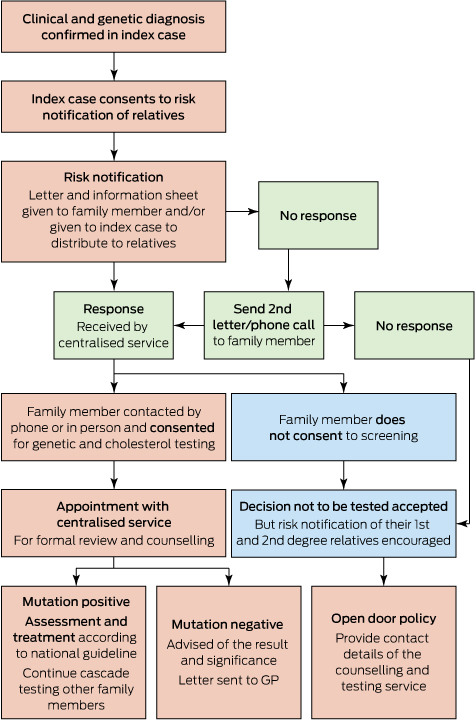
Recent reports from Western Australia confirm that cascade screening is efficacious and cost-effective.11,14 The genetic cascade screening and risk notification process followed in Western Australia is shown in Box 2.11 Cascade screening involves testing close relatives of individuals diagnosed with FH. The autosomal dominant inheritance suggests 50% of first-degree relatives would be expected to have FH. Two new cases of FH were found by cascade screening for each index case in WA.11 These individuals were younger and had less atherosclerotic CVD than index cases. Interestingly, about 50% were already on lipid-lowering therapy, but they were not treated to the recommended goals and further lipid reductions were achieved overall. Over 90% of patients were satisfied with the cascade screening process and care provided by this service .11 However, for individuals who have not had genetic testing performed, or for individuals with clinical FH in whom a mutation has not been identified, cascade screening should also be undertaken using LDL-c alone.

Although we have recently shown that genetic testing is cost-effective in the cascade screening setting ($4155 per life year saved),14 only a few centres in Australia have this facility and testing is currently not Medicare rebatable. However, combining increased awareness of the benefits of identifying people with FH with the reducing analytical costs may increase the use of genetic testing. This in turn could guide advocacy and lobbying Medicare to support genetic testing for FH.

Detecting FH in the community

A novel approach that utilises the community laboratory to augment the detection of FH has recently been tested in Australia. The community laboratory is well placed to perform opportunistic screening, since they perform large numbers of lipid profiles, the majority (> 90%) of which are requested by general practitioners.15 Clinical biochemists can append an interpretive comment to the lipid profile reports of individuals at high risk of FH based on their LDL-c results. These interpretive comments on high risk individuals (LDL-c ≥ 6.5 mmol/L) led to a significant additional reduction in LDL-c and increased referral to a specialist clinic.16 A phone call from the clinical biochemist to the requesting GP improved both the referral rate of high risk (LDL-c ≥ 6.5 mmol/L) individuals to a lipid specialist and the subsequent confirmation of phenotypic FH in 70% of those referred, with genetic testing identifying a mutation in 30% of individuals.17 There is a list of specialists with an interest in lipids on the Australian Atherosclerosis Society website (http://www.athero.org.au/fh/health-professionals/fh-specialists).

In Australia, GPs consider they are the best placed health professionals to detect and treat individuals with FH in the community.18 A large primary care FH detection program in a rural community demonstrated that using pathology and GP practice databases was the most successful method to systematically detect people with FH in the community.19 However, a survey of GPs uncovered some key knowledge deficits in the prevalence, inheritance and clinical features of FH, which would need to be addressed before GPs can effectively detect and treat individuals with FH in the community.18 A primary care-centred FH model of care for Australia has recently been proposed to assist GPs with FH detection and management, but this requires validation.20 The model of care includes an algorithm that is initiated when an individual is found to have an LDL-c level ≥ 5.0 mmol/L, which could be highlighted as at risk of FH by either a laboratory or the GP practice software.20,21 The doctor is then directed to calculate the likelihood of FH using the DLCNC. Patients found to have probable or definite FH are assessed for clinical complexity and considered for cascade testing. See the Appendix at mja.com.au for the algorithm and definition of complexity categories. FH-possible patients should be treated according to general cardiovascular disease prevention guidelines.

Molecular aspects

There have also been advances in molecular aspects of FH. A recent community-based study in the United States confirmed that among patients with hypercholesterolaemia, the presence of a mutation was independently predictive of CVD, underscoring the value of genetic testing.22 The mutation spectrum of FH was described in an Australian population and was found to be similar to that in Europe and the United Kingdom.23 Mutation detection yields in Australia are comparable with the international literature; for example, 70% of individuals identified with clinically definite FH (DLCNC score > 8) had an identifiable mutation, whereas only 30% of those with clinically probable FH had a mutation.23

Polygenic hypercholesterolaemia (multiple genetic variants that each cause a small increase in LDL-c but collectively have a major effect in elevating LDL-c levels) is one explanation for not identifying an FH mutation. An LDL-c gene score has been described to differentiate individuals with FH (lower score) from those with polygenic hypercholesterolaemia (higher score), but this requires validation.24 About 30% of individuals with clinical FH are likely to have polygenic hypercholesterolaemia, and cascade screening their family members may not be justified.25

A further possible explanation for failure to detect a mutation causative of FH in an individual with clinically definite FH may lie in the limitations of current analytical methods such as restricting analysis to panels of known mutations. Further, FH is genetically heterogeneous and there may be unknown alleles and loci that cause FH. Next generation sequencing is capable of sequencing the whole genome or targeted exomes rapidly at a relatively low cost, and may improve mutation detection and identify novel genes causing FH, but further experience with its precise value in a clinical setting is required. Whole exome sequencing was able to identify a mutation causing FH in 20% of a cohort of “mutation negative” but clinically definite FH patients.25 However, when applied to patients with hypercholesterolaemia in a primary care setting, pathogenic mutations were only detected in 2% of individuals, with uncertain or non-pathogenic variants detected in a further 1.4%.26

Cardiovascular risk assessment

Absolute CVD risk assessment, employing risk factor counting, should be performed as atherosclerotic CVD risk is variable in FH.10,27 This involves appraisal of classic CVD risk factors including, age, sex, hypertension, diabetes, chronic kidney disease and smoking. The prevalence of classic CVD risk factors among Western Australians with recently identified FH was 13% for hypertension, 3% for diabetes and 16% for smokers, all of which were amenable to clinical intervention.11

Other non-classic CVD risk factors are also important for individuals with FH, especially chronic kidney disease and elevated levels of lipoprotein(a).28 Lipoprotein(a) is a circulating lipoprotein consisting of an LDL particle with a covalently linked apolipoprotein A. Its plasma concentration is genetically determined and it is a causal risk factor for CVD in both the general population and FH patients.29,30 Lipoprotein(a) concentrations are not affected by diet or lowered by statins.31

Management and new therapies

The past 2 years have also seen the development of new treatments for FH, but lifestyle modifications and statins remain the cornerstones of therapy for FH. Ezetimibe has been demonstrated to reduce coronary events against a background of simvastatin in non-FH patients with established CVD.32 PCSK9 inhibitors have recently been approved to treat individuals with FH or atherosclerotic CVD not meeting current LDL-c targets in Europe and America. PCSK9 is a hepatic convertase that controls the degradation and hence the lifespan of the LDL receptor. PSCK9 is secreted by the hepatocyte and binds to the LDL receptor on the surface of the hepatocyte. The LDL receptor–PCSK9–LDL-c complex is then internalised via clathrin-dependent endocytosis, but the PSCK9 directs the LDL receptor towards lysosomal degradation instead of recycling it back to the hepatocyte surface.33 A recent meta-analysis of early PCSK9 inhibition trials involving over 10 000 patients demonstrated a 50% reduction in LDL-c, a 25% reduction in lipoprotein(a), and significant reductions in all-cause and cardiovascular mortality.34

The PCSK9 inhibitors alirocumab and evolocumab were approved by the European Medicines Agency in 2016 for homozygous and heterozygous FH and non-FH individuals unable to reach LDL-c targets, and for individuals with hypercholesterolemia who are statin intolerant. In the US, the Food and Drug Administration has approved alirocumab for heterozygous FH and individuals with atherosclerotic CVD who require additional reduction of LDL-c levels. Evolocumab and alirocumab have recently been approved by the Therapeutic Goods Administration in Australia for people with FH. Adverse events are generally similar to placebo, but reported side effects include influenza-like reaction, nasopharyngitis, myalgia and raised creatine kinase levels, and there have been reports of neurocognitive side effects (confusion, perception, memory and attention disturbances).34 The cost of these agents is likely to be the major limitation to their clinical use. The indications and use of lipoprotein apheresis and other novel therapies, including lomitapide, a microsomal triglyceride transfer protein inhibitor, and mipomersen (an antisense oligonucleotide that targets apolipoprotein B), have been recently reviewed.35

Despite the advances reviewed, the implementation and optimisation of models of care for FH remain a major challenge for preventive medicine. Areas of future research should focus on better approaches for detecting FH in the young and on enhancing the integration of care between GPs and specialists. The value of genetic testing and imaging of pre-clinical atherosclerosis in stratifying risk and personalising therapy merits particular attention. Further, with families now living in a global community, more efficient methods of communication and data sharing are required. This may be enabled by international Web-based registries.36 Care for people with FH needs to be incorporated into health policy and planning in all countries.10

Conclusion

There have been significant advances in the care of individuals with FH over the past 3 years. An integrated model of care has been proposed for primary care in Australia. Progress has also been made in the treatment of FH with the emergence of PCSK9 inhibitors capable of allowing more patients already on statins to attain therapeutic LDL-c targets and hence redressing the residual risk of atherosclerotic CVD. Future research is required in the areas of models of care, population science and epidemiology, basic science (including genetics), clinical trials, and patient-centric studies.37 Finally, the onus rests on all health care professionals to improve the care of families with FH, in order to save lives, relieve suffering and reduce health care expenditure.

Box 1 –
Dutch Lipid Clinic Network Criteria score for the diagnosis of familial hypercholesterolaemia (FH)2

Criteria

Score


Family history

First-degree relative with known premature coronary and/or vascular disease (men aged < 55 years, women aged < 60 years); or

1

First-degree relative with known LDL-c > 95th percentile for age and sex

First-degree relative with tendon xanthomas and/or arcus cornealis; or

2

Children aged < 18 years with LDL-c > 95th percentile for age and sex

Clinical history

Patient with premature coronary artery disease (ages as above)

2

Patient with premature cerebral or peripheral vascular disease (ages as above)

1

Physical examination

Tendon xanthomata

6

Arcus cornealis at age < 45 years

4

LDL-c

≥ 8.5 mmol/L

8

6.5–8.4 mmol/L

5

5.0–6.4 mmol/L

3

4.0–4.9 mmol/L

1

DNA analysis: functional mutation in the LDL receptor, apolipoprotein B or PCSK9 gene

8

Stratification

Definite FH

> 8

Probable FH

6–8

Possible FH

3–5

Unlikely FH

< 3


LDL-c = low-density lipoprotein cholesterol. PCSK9 = proprotein convertase subtilisin/kexin type 9.

Box 2 –
Protocol for genetic cascade screening in Western Australia*


* Family cascade screening process performed according to national guidelines2 after obtaining written consent from the index case.11 This was undertaken by a trained nurse who contacted the family members and obtained verbal consent to contact further family members, after providing counselling and offering specialist review as indicated.

Doctors need to be taught how to discuss their patients’ excess weight

With 80% of adults and close to one-third of children expected to be overweight or obese by 2025, doctors are increasingly likely to be working with people who are overweight or obese.

An individual’s weight is a complex and sensitive issue, which may be related to many factors that are not only medical but social, environmental and emotional. The skills to address the issue in a way that communicates the health risks of being overweight without judgement and without inciting negative responses are not easy to acquire or universally taught.

Health professionals repeatedly report a lack of confidence in knowing how to address obesity in their patients. They report minimal, if any, training on obesity as well as limited resources for effective conversations and insufficient clinical time to be able to do this well.

Starting a conversation about weight requires not only empathy but awareness of strategies people can use to manage weight issues and an understanding of the range of local services available to assist. It has been shown that although behavioural and medical strategies can be effective, uninformed discussion in the clinic can disengage, stigmatise or shame patients, which then has negative impacts on the outcomes.

Many patients do expect weight-loss guidance from health professionals and the discussion can influence outcomes. In fact, having the conversation and formally diagnosing and documenting excess weight or obesity is the strongest predictor of having a treatment plan and weight-loss success.

Choice of language is crucial

Research has identified the terms “fat” and “fatness” are the least preferred terms. The words “obese” and “obesity” have also been found to arouse negative responses. The National Institute of Clinical Excellence in the UK suggests patients may be more receptive if the conversation is about achieving or maintaining a “healthy weight”.

The STOP Obesity Alliance in the US suggests using “people first” language such that a person “has” obesity rather than “is” obese, similar to “having” cancer or diabetes.

This is part of a debate about whether obesity should be labelled as a disease rather than a risk factor.

Regardless of how this issue is classified, doctors and patients both require the knowledge to understand effective therapies do exist and obesity treatment is not futile. Losing 5-10% of body weight can have a significant impact on risk factors such as blood pressure and can lower the risks of later health problems such as heart disease or type 2 diabetes.

This sort of weight loss also often improves other factors more immediately beneficial to the patient, such as energy levels, mood and mobility.

A communication style that encourages shared decision-making and helps people change their behaviour is key. The objective is not to solve the problem but to help the patient begin to believe change is possible and develop a plan about health goals.

Let’s take the case of a woman who presents with urinary incontinence. The woman may describe the problem of needing to wear sanitary pads because of daily leaking of urine. Factors such as obesity will worsen the problem, but the woman may not be aware of this.

The doctor might say:

“I hear you’re concerned about your loss of urine, is that correct? Let’s talk about that; and would it be OK to discuss your weight too, as that may be related?”

The practitioner might listen for a willingness to have further discussion and then pose a goal-orientated question:

“If, as part of our plan to help your urinary symptoms, you decide to work on getting to a healthier weight, what might be a first step?”

Repercussions for our kids

For men and women of reproductive age the conversation is potentially not just about their own health but also about that of their children. Women who have higher pre-conception weight and pregnancy weight gain are at increased risk of developing diabetes and heart disease in later life and are less likely to lose weight after they give birth.

This vicious cycle results in larger babies that are predisposed to short-term risks as newborns, longer-term risks of increased childhood obesity and an increased lifetime risk of obesity, diabetes and heart disease.

Between 1985 and 1995 the rate of excess weight and obesity in childhood increased by 50% and obesity tripled in Australia. Animal studies also suggest obesity in the male parent can increase the chance of their offspring developing obesity or diabetes.

The intergenerational nature of obesity therefore means until we address overweight and obesity in adults who are planning a pregnancy, it may be impossible to lower rates of childhood obesity.

The framing of the issue as a problem for patients’ own health as well as for the health of their children is even more complex. However, unless there is a greater understanding of this risk and more training of doctors in talking to patients about obesity this will be difficult to tackle.

Currently, many health professionals remain uncomfortable and unsure in this area of practice. Ensuring the workforce is skilled will also mean there is the ability to discuss weight when it is not the primary issue a patient presents with, but where an important conversation at a critical life stage may actually have lasting effects on patients’ health and that of their children.

Adrienne Gordon, Neonatal Staff Specialist, NHMRC Early Career Research Fellow, University of Sydney and Kirsten Black, Associate Professor & Joint Head of Discipline Obstetrics, Gynaecology and Neonatology, University of Sydney

This article was originally published on The Conversation. Read the original article.

Other doctorportal blogs

Remote Australians more likely to be hospitalised with heart-related issues

Patients from very remote Australia are nearly twice as likely to need a hospital for a heart-related event.

The Heart Foundation has released heart-related hospital admissions data maps, revealing huge gaps between city dwellers and those living in remote Australia.

Heart Foundation National Chief Executive Officer Adjunct Professor John Kelly said the maps bring together a national picture of hospital admission rates for the first time.

“Those regions that rate in the top hotspot areas are regions where a large proportion of residents are of significant disadvantage. This disadvantage includes a person’s access to education, employment, housing, transport, affordable healthy food and social support,” he said.

“This contrasts to areas with the lowest rates – particularly the northern suburbs of Sydney, where there is little disadvantage of the community.

Related: Australian clinical guidelines for the management of acute coronary syndromes 2016

“There is a five-fold difference of hospital admissions between Northern Territory Outback and the region with the lowest admission rates North Sydney & Hornsby, which highlights the association between remoteness, disadvantage and our heart health.”

The heart maps reinforce the knowledge that heart admissions are correlated with obesity, smoking and physical activity.

However Professor Kelly points out that the differences are not because people from disadvantaged areas make unhealthy choices.

“They are the result of a combination of social, economic and physical conditions, like a person’s access to education, employment, housing, transport, affordable healthy food, and social support,” he explained.

Related: Disparities in cardiac care must end

“These conditions shape matters such as people’s eating habits, participation in physical activity and their likelihood to see a doctor.

He said governments and health services need to work together to provide access and opportunities for people in more remote locations.

“Prevention programs work, simple early detection and heart health checks by doctors can help early identification of the risk factors and reduce hospital admissions.

“Health is a basic human right. It should not matter who you are, how much you earn or where you live,” he said.

Top 5 Regions for Heart-Related Hospital Admissions

Remote Australians more likely to be hospitalised with heart-related issues - Featured Image

Top 5 Regions with the lowest heart-related hospital admission rates

Remote Australians more likely to be hospitalised with heart-related issues - Featured Image


Latest news:

Striving for truly healthy growth

The limitations of political slogans – the ‘privatisation of Medicare’ or ‘jobs and growth’ – are severe. Ideas are shorn of nuance and words stripped of definition. What is meant by ‘privitisation’ and ‘Medicare’, and what by ‘growth’?

While privatising Medicare may at first blush be the phrase of greatest interest to doctors, I suggest that ‘growth’ is of deeper concern. Growth – unqualified – could be a curse and not a cure, a health hazard rather than a health promoter, a cancerous thing rather than a positive developmental pathway.

True, decades of free market-based economic growth have achieved remarkable improvements in global health. Whole nations have been lifted from poverty, death and suffering. In economically-advanced nations unimaginable affluence has been achieved with improved average life expectancy.

But with this growth have come unintended side effects. The global challenge of climate change is one such consequence. Inequality is another. In the US, the rich have become disproportionately richer without improvement in economic well-being among workers. This has substantial political effects. Commentators speak of how this inequality, present also in the UK, has contributed to Trump and Brexit.

Growth with attitude

Jeffrey Sachs, an economist at Columbia University with a long-standing passionate interest in sustainable development and health in less developed economies, wrote recently in the Boston Globe about the need for a fresh understanding of what we mean by growth. Sachs played a major part in the development of what are called the Sustainable Development Goals, or SDGs, under the auspices of the United Nations. The goals were agreed upon one year ago by more than 100 nations, including Australia. 

In brief, the SDGs, to quote Sachs, aim at economic growth, but defined in a manner that promotes decency and environmental sustainability. The 17 goals involve the achievement of more than 100 specific objectives. They fall into three groups: those associated with classical economic progress; those that have to do with ensuring environmental sustainability; and those that concern justice and social fairness.

Now, almost a year later, in New York on July 20, ministers and country representatives at the annual UN High-Level Political Forum attended the launch of an index, a measuring device, designed to allow countries to assess how they stand now in relation to the SDGs, and how they can judge their progress. The index is aimed at strengthening the commitment to growth in a way that is consistent with improving human decency and honouring the environment. It provides a current assessment for 149 of the 193 UN member states. It asks each nation to rank itself on indicators of poverty, nutrition, health care, education and pollution – all elements of the SDGs.

The goals include universal education, gender equality, clean water and sanitation, affordable clean energy, decent work and economic growth, reducing inequalities and developing sustainable cities.

Three are of special interest to medical and other health professionals. They concern further efforts to reduce poverty; to do what is needed to promote health and wellbeing; and to ensure food security for all.

In one sense these goals could hardly be disputed. But the real question is whether they have enough grunt to motivate change.

Critics, including The Economist, refer to the goals as “sprawling” and not sufficiently specific, especially when compared with the much fewer (12) Millennium Development Goals that were associated with great progress in infant mortality, HIV and other forms of health promotion and disease control for example.

Nevertheless, despite the ambitious spread of the SDGs, they take account of current urgent global challenges from which Australia cannot hope to remain immune.

Moving Australia toward sustainable growth

The world leaders on the SDG index are the Scandinavian countries, followed by others from Northern Europe. Canada was 13th, Australia 20th and the US 25th. Sweden’s homicide rate is around one-seventh of America’s, and its incarceration rate one-tenth. Infant and maternal mortality rates are lower, as is income inequality.

In summary, the SDGs are an international expression of an attempt to seek truly global health – for people, the environment and the planet.

While achieving these goals is a lofty ideal, we can only make progress if we use words like ‘growth’ accurately. If we mean growth that advances the economy while also promoting environmental sustainability and reducing social inequality, then we will be on a solid path to the future.


[Correspondence] Risk factors for neonatal disorders and the Global Burden of Disease

We read with interest the Global Burden of Disease study 2013 (Dec 5, 2015; pp 2287–323).1 The authors’ conclusion that the 79 behavioural, environmental and occupational, and metabolic risks studied jointly explained none of the outcomes in neonatal disorders is, we believe, highly implausible. Many of the risk factors that were studied predispose women to severe adverse pregnancy outcomes via maternal exposure.2–5 For example, consistent evidence links household air pollution to low birthweight and stillbirth;4 maternal smoking to congenital anomalies, stillbirth, preterm birth, and low birthweight;5 and high maternal body-mass index to stillbirth and neonatal mortality.

Your postcode shouldn’t determine your health – or whether you’re admitted to hospital

People ending up in hospital for diabetes, tooth decay, or other conditions that should be treatable or manageable out of hospital is a warning sign of system failure. And Australia’s health system is consistently failing some communities.

A Grattan Institute report, Perils of place: identifying hotspots of health inequalities, released today, identifies a number of geographical areas where high rates of potentially preventable hospital admissions have persisted for a decade. This is unacceptable place‑based inequality.

Using data from Queensland and Victoria, the report identifies 38 places in Queensland and 25 in Victoria that have had potentially preventable hospitalisation rates at least 50% higher than the state average in every year for a decade. There is no evidence to suggest the pattern is any different in other states and territories.

Reducing potentially preventable hospitalisations in these places to average levels would save at least A$10 million a year for the Queensland and Victorian health systems. Indirect savings, such as improving the productivity of the people affected, should be significantly larger.

Different places, different problems

Some of the areas identified as having high rates of potentially preventable admissions were in remote areas such as Mt Isa in Queensland. Others were in suburban centres such as Broadmeadows in Melbourne.

In some places, the high rates of admissions were driven by high rates of re-admissions – a small number of people each having a large number of admissions each year. In these places, better targeting care to high-risk individuals may help to reduce rates.

Yet in other places, re-admissions did not contribute to the problem at all.

Areas that have a low socioeconomic status, are regional, and/or have a high proportion of Indigenous people are more likely to experience health inequalities.

But even in Australia’s most disadvantaged areas, persistently high rates of potentially preventable hospitalisations are rare. Because many such areas have low rates of potentially preventable hospitalisations, examining why some have a problem while others do not may help to understand what needs to improve.

What can governments do about it?

The Grattan Institute’s report has three clear messages for governments and local health agencies such as Primary Health Networks.

First, make sure prevention efforts are focused in places where high rates of potentially preventable hospitalisations have existed for a while. These are the places where health inequalities are already entrenched and, without intervention, are most likely to endure.

On average, about half of areas which had a high rate of potentially preventable hospitalisations in one year had dropped back to closer to the state average the next year (55% in Victoria, 45% in Queensland). This means that if governments or Primary Health Networks make their intervention decisions based on just one year of data, they will have a false sense of reassurance that their interventions are working when in fact their success might just be the result of random chance.

Second, think local. Australia is not a uniform country and a one-size-fits-all approach will not work. Some areas may have excellent local primary health care services but, in the face of very severe disease burdens, the area ends up with a high rate of potentially preventable hospitalisations. Other areas might have poor access to primary care services.

There is no uniform pattern for the causes of high rates of potentially preventable hospitalisations. Tailored policy responses are required.

Primary Health Networks have been given responsibility to identify and address health needs in their regions. They must identify the areas with high rates of potentially preventable hospitalisations and distil why these rates are occurring. They then need to design locally tailored responses, in partnership with local health authorities and communities.

Unfortunately, there is as yet only limited evidence of what works in reducing potentially preventable hospitalisations. Governments should therefore invest in trials to reduce potentially preventable hospitalisations in places identified as having high rates.

The cost-effectiveness of interventions must be established on a small scale before they are rolled out to further areas.

This leads to the third message: interventions must be rigorously evaluated so they expand the evidence about what works. As Primary Health Networks become more sophisticated at identifying the people most in need and as the evidence from trials builds, efforts to reduce health inequalities should be strengthened and expanded beyond the priority places identified here.

The role of place in shaping people’s health and opportunity is well-established. Governments and Primary Health Networks must ensure all communities get a fair go.

Improving the health of people in these places with high rates of potentially preventable hospitalisations will, in the long-run, reduce health costs. Even more importantly, it will increase social cohesion and inclusion, workforce participation and productivity, by making many more people healthy and able to make the most of their lives.

Stephen Duckett, Director, Health Program, Grattan InstituteThe ConversationThis article was originally published on The Conversation. Read the original article

Other doctorportal blogs

What to tell your patients who are travelling to Brazil

With the Olympic Games in Brazil starting in less than a month, Australia’s retiring Chief Medical Officer, Professor Chris Baggoley has released some important health messages for spectators travelling to the Games.

Brazil is experiencing a Zika virus outbreak and there is also the presence of other mosquito-borne diseases including yellow fever, dengue and chikungunya.

The vaccine for yellow fever should be given at least 10 days before travellers arrive in Brazil. Travellers should be aware that many countries, including Australia, need proof of yellow fever vaccination before they allow entry so they should ensure they have their yellow fever certificate when they travel.

GPs are being urged to ensure patients are made aware of the risks involved in visiting Brazil, particularly women who are pregnant or seeking to become pregnancy as Zika virus can cause severe birth defects, including microcephaly.

Women who are pregnant or seeking to become pregnant should defer travel to Zika affected areas including Brazil.

Related: Protection of Olympian proportions

For those who aren’t pregnant or seeking pregnancy, they should take these precautions to avoid mosquito bites:

  • Use insect repellent containing DEET or picaridin.
  • Wear light-coloured clothing that covers as much skin as possible.
  • Ensure there are fly screens or air conditioning at accommodation.
  •  If the accommodation doesn’t have those options, sleep under a mosquito net.

Regarding the sexual transmission of Zika virus, travellers should be advised:

  • Men who travel to Brazil and who have a pregnant partner should abstain from sex or use condoms for the duration of the pregnancy.
  • For couples planning pregnancy and travelling to the Games, it’s recommended women wait at least 8 weeks for attempting pregnancy. If the woman’s partner travelled with her and contracts Zika, they might have to wait 6 months before trying for pregnancy.
  • Men travelling to a Zika affected area should avoid unprotected sex for 8 weeks after returning.

GPs are encouraged to display this poster in their practice and give this brochure to patients travelling to the Games. This information is designed to inform travellers on how they can reduce the risks of contracting Zika virus, get travellers thinking about yellow fever vaccination, and instruct travellers on how they can protect themselves from mosquito-borne illness.

To obtain hard copies of either the brochure or the poster, please email humanquarantine@health.gov.au with your details and quantity needed and they will be mailed out. More information is available on the Department’s website at health.gov.au/rio2016 or email humanquarantine@health.gov.au.

Latest news: