×

What doctors should know about the Trans-Pacific Partnership Agreement

How this new breed of trade agreement could affect public health and access to medicines

Macroeconomic policy decisions can seem far removed from day-to-day medical practice; however, these high-level policy decisions about trade and economic policy have far-reaching consequences and can undermine effective health policy and practice.

The Trans-Pacific Partnership Agreement

The Trans-Pacific Partnership Agreement (TPPA), currently under negotiation, represents a new breed of trade agreement.1 It will include the traditional focus areas, like removing import taxes and enabling foreign companies to provide services in Australia; and it is believed it will provide new protections for investors and intellectual property. The TPPA is aimed at changing policy making within countries and harmonising domestic policy requirements affecting trade and investment across the countries involved.2

As a new-style agreement, the TPPA has greater potential to affect domestic health policy and, ultimately, the quality of health services and public health.3 For example, leaked documents show that an investor–state dispute settlement mechanism is being negotiated for the TPPA. This enables foreign investors — including companies that manufacture, market and distribute health-damaging products — to directly seek compensation from governments for policies that negatively affect them. A similar mechanism in another treaty enabled Philip Morris Asia to sue the Australian Government over plain tobacco packaging.4 Similarly, moves to harmonise policies within signatory countries that affect traded goods can result in a move to the lowest common denominator and can limit public health protections related to medicines, tobacco, alcohol and food.

Australia, Brunei Darussalam, Canada, Chile, Japan, Malaysia, Mexico, New Zealand, Peru, Singapore, the United States and Vietnam are involved in TPPA negotiations.5 These countries have diverse approaches to health care and public health, which are likely to be reflected in their negotiating platforms. While the Australian Government has stated it will not enter into an agreement that compromises public health, independent assessment of the implications for public health is severely limited by lack of transparency in the negotiations (the agreement will not be made public until after it is signed).6

Main areas of concern for doctors

One of the key concerns for doctors is access to medicines. Intellectual property rules proposed for the TPPA, if adopted, are likely to prolong monopolies over new medicines and delay the availability of cheaper generics.4,7 Resulting cost blowouts to the Pharmaceutical Benefits Scheme (PBS) would play out for patients in higher copayments and reduced access to expensive new treatments, with disadvantaged patients bearing much of the burden.8 Changes to PBS processes also proposed for the TPPA could compound these problems by preventing effective price regulation and giving the pharmaceutical industry more say in PBS decision making.4,7 In addition, pharmaceutical companies may be able to use the investor–state dispute settlement mechanism to sue, or threaten to sue, governments over their pharmaceutical policies. Pharmaceutical company Eli Lilly and Company is currently using an investor–state dispute settlement mechanism to sue the Canadian Government for invalidating patents for two drugs that were found not to deliver the promised benefits.8

The TPPA could also make the shared task of tackling chronic non-communicable diseases such as diabetes and heart disease more difficult. Prevention through supportive environments is an essential corollary to general practitioner-based primary prevention. Nevertheless, the rules of these new trade agreements that are focused on domestic policy can reduce the options available to government for regulating products associated with non-communicable disease prevention, namely tobacco, alcohol and food.9 For example, proposed rules on transparency and regulatory coherence in the TPPA would enshrine the right of industry (both local and international) to contribute to national nutrition policy making. This works against public health efforts to reduce the influence of vested interests on policy design and implementation. Without strong population-based prevention, such as clear labelling of health risks, limitations on advertising and price incentives to reduce consumption (all strongly opposed by industry), the burden falling on GP-based primary prevention will continue to grow.

Doctors should also be concerned about the implications of the TPPA for health services. The TPPA is expected to include rules to ensure private companies can compete on an equal footing with publicly funded or provided services.10 Owing to limited public information, it is difficult to establish how current and future public health services will be affected. But if parts of the health system are privatised (such as Medicare claims processing and primary health care networks), this may not be reversible under the TPPA, regardless of any subsequent evidence of detrimental effects of such privatisation.

What doctors can do

The Australian Medical Association and the Public Health Association of Australia have raised concerns about the potential impact of the TPPA on public health and access to medicines.6,11 Such input is essential for awareness among policymakers of the cross-sectoral implications of trade policy decisions. Doctors can help to protect public health by highlighting the effects of proposed provisions on patients, opposing health-damaging provisions, arguing for the agreement to be worded in ways that protect public health and seeking greater transparency in the TPPA negotiations.

When the light begins to fade

Being mortal is about the struggle to cope with the constraints of our biology, with the limits set by genes and cells and flesh and bone. Medical science has given us remarkable power to push against these limits, and the potential value of this power was a central reason I became a doctor. But again and again, I have seen the damage we in medicine do when we fail to acknowledge that such power is finite and always will be.

We’ve been wrong about what our job is in medicine. We think our job is to ensure health and survival. But really it is larger than that. It is to enable well-being. And well-being is about the reasons one wishes to be alive.

Atul Gawande. Being mortal. London: Profile Books, 2014.

Atul Gawande, 49, is a general surgeon at the Brigham and Women’s Hospital in Boston and holds academic positions in the Harvard Medical School and School of Public Health. He is also a writer. Being mortal uses both his clinical experiences and literary skills as they relate to the care we give, or should give, when our patients enter the twilight zone between responsiveness to medical and surgical interventions and when they move beyond the reach of our finest instruments and technical remedies.

The central question of the book is not new, nor are the answers. The question is this: given the inevitable decline in capacity as we age, especially when sick, how can medicine best assist us? The answer is that by determining what it is that patients perceive to be what gives their life purpose, we should work with them so that it can be achieved. Of course, that is not always possible but it is more likely than we may think.

The book is packed with cases that demonstrate that this is so. Each page is informed by Gawande’s clinical experiences, including interviews with hundreds of patients and family members about their experiences of illness and ageing, as well as discussions with health care workers including aged care, nursing, palliative care specialists, geriatricians and other experts in the field.

Gawande’s arguments derive from, and are informed by, the immediacy of his clinical practice. The book contains eight chapters: The Independent Self, Things Fall Apart, Dependence, Assistance, A Better Life, Letting Go, Hard Conversations, Courage, and a personal epilogue about Gawande’s experience as he shared his father’s final journey over years with cancer.

Gawande was born to Indian parents (both doctors) in Brooklyn and grew up in Athens, Ohio. He graduated first from Stanford in 1987 and was a Rhodes Scholar in philosophy, politics and economics at Balliol College, Oxford, in 1989. He completed his medical studies at Harvard in 1995. A political activist, he helped the first Clinton presidential campaign and worked on his ill fated health care reform efforts. He has published highly acclaimed articles with The New Yorker on medical matters (including the chapter in this book entitled Letting Go) and became a staff writer there in 1998. He gave the 2014 Reith Lectures on BBC Radio 4 on The Future of Medicine; his first presentation entitled Why do Doctors Fail? He wrote Being mortal at the Rockefeller villa in Bellagio, Italy.

The medical curriculum and mortality

Gawande observes:

I learned about a lot of things in medical school, but mortality wasn’t one of them . . . What worried us was knowledge . . . Yet within a few years, when I came to experience surgical training and practice, I encountered patients forced to confront the realities of decline and mortality, and it did not take long to realize how unready I was to help them.

His is not a book about palliative care and certainly not about euthanasia, although both feature in it: rather, it is about discerning together with patients and carers who have entered the twilight zone what their wishes are about the life that lies ahead of them, and then making judicious choices — sometimes heroic, sometimes quiet and low-key — in relation to therapy and support that are most likely to enable and enhance those choices.

People with serious illness have priorities besides simply prolonging their lives. Surveys find that their top concerns include avoiding suffering, strengthening relationships with family and friends, being mentally aware [even at the expense of foregoing narcotic analgesics], not being a burden on others, and achieving a sense that their life is complete . . . The question therefore is not how we can afford [our system of technological care]. It is how we can build a health care system that will actually help people achieve what’s important to them at the end of their lives.

Gawande heads up a health system innovation centre at Harvard.

Gawande’s book is a gallery of portraits of patients, carers and doctors and a document of conversations with them that reassure, challenge and inspire. Oliver Sacks, himself a great medical writer, says:

Being Mortal is not only wise and deeply moving, it is an essential and insightful book for our times, as one would expect from Atul Gawande, one of our finest physician writers.1

Late for Christmas? Consider giving yourself a copy for the new year!

An economic case for a cardiovascular polypill? A cost analysis of the Kanyini GAP trial

There is increasing global interest in the use of frequently indicated medications in fixed-dose combination for the prevention of cardiovascular disease (CVD).1,2 Evidence of the effectiveness of such polypills as a strategy in improving adherence to recommended treatment and potentially lowering costs is growing.3,4 Although there are combination blood pressure-lowering and cholesterol-lowering medications, a more comprehensive cardiovascular polypill (containing generic aspirin, a lipid-lowering and two blood pressure-lowering agents) is not currently available in Australia. At a feasible cost of less than $1 per day5 compared with a minimum cost in Australia of $1.70 per day for individual generic therapies (http://pbs.gov.au/info/about-the-pbs), prima facie evidence exists for extensive savings from such a strategy in Australia.

The cost-effectiveness of polypill-based strategies compared with individual medications has yet to be tested in real-life settings, although cost-effectiveness has been shown in different patient groups and health care settings using modelled projections.5,68 For instance, based on a modelled analysis of high-risk primary care Dutch participants, polypill use after opportunistic screening was cost-effective among people aged over 40 years.8 Similarly, a polypill strategy was found to be cost-effective and potentially cost-saving in older patients after myocardial infarction.7

This analysis is based on the Kanyini Guidelines Adherence with the Polypill (GAP) pragmatic randomised controlled clinical trial and linked health service and medication administrative claims data from Medicare Australia. Kanyini GAP was pragmatic in that it was conducted within the primary care setting, with the study drug dispensed through community pharmacies, to test the effectiveness of a polypill-based strategy in real-world practice.9 In the trial, the polypill improved patients’ adherence to treatment and there was no difference in mean blood pressure and cholesterol levels.3 The results were consistent with a larger sister trial, the UMPIRE (Use of a Multidrug Pill in Reducing Cardiovascular Events) study. Conducted in Europe and India, UMPIRE found that a polypill strategy yielded improvements in self-reported adherence, along with statistically significant but small additional reductions in blood pressure and cholesterol, compared with non-polypill treatment, in the polypill arm.4 A unique design feature of Kanyini GAP was that all medications, including the polypill, were dispensed at an out-of-pocket charge consistent with prevailing Medicare subsidies (around $35 per medication per month for general patients).

Methods

A within-trial cost analysis of the polypill strategy versus usual care was conducted from the Australian health system perspective (ie, government plus patient costs). Kanyini GAP was carried out within Indigenous and non-Indigenous urban, rural, and remote primary care settings across Australia (randomisation from January 2010 to May 2012; median follow-up, 19 months; maximum follow-up, 36 months).3

Data on health service and medication expenditure throughout Kanyini GAP were obtained via individually linked Australian Medicare records for study participants who consented to linkage. Two separate Medicare datasets were analysed: the Medicare Benefits Schedule (MBS), which records government and patient costs of general practitioner and specialist visits and diagnostic tests; and the Pharmaceutical Benefits Scheme (PBS), which records the total government and patient costs of all medications dispensed outside hospital. The PBS data do not include polypill costs, as it is not marketed in Australia. As no difference was found in safety or clinical outcomes between treatment groups in the Kanyini GAP trial, we assumed no differences in hospital-related expenditure.

The primary outcome was mean MBS and PBS expenditure per patient per year. The base year for the analysis was 2012.10 This study was approved by human research ethics committees in all relevant jurisdictions (Sydney South West Area Health Service; Aboriginal Health and Medical Research Council of New South Wales; Cairns Base Hospital; Princess Alexandra Hospital Centres for Health Research; Central Australia; Northern Territory Department of Health and Menzies School of Health Research; Monash University). Each participant provided written informed consent.

Statistical analysis

Multivariable analysis was conducted to accommodate potential differences between treatment groups, given these analyses were restricted to the subset of trial participants consenting to Medicare linkage.11 Non-significant demographic, socioeconomic, health and treatment-related covariates (P > 0.10) were removed via backwards stepwise elimination. To account for the empirical distribution of MBS and PBS cost data,1114 generalised linear models were used to estimate the primary outcome, and the marginal difference between treatment groups was compared (Wald test). Deb–Manning–Norton programs for Stata 12.1 (StataCorp) were used.12

Results

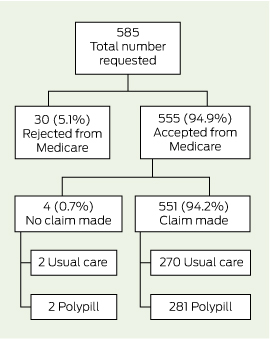
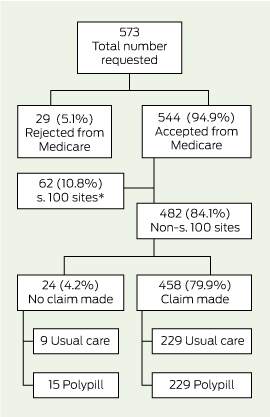
Box 1 and Box 2 detail the flow of patients through this analysis. Consent for linkage with MBS and PBS data was obtained from 93.9% (585/623) and 92.0% (573/623) of trial participants, respectively, and data were provided for 94.9% of participants (MBS, 555/585; PBS, 544/573). With regard to PBS data, 10.8% (62/573) of consenting participants were receiving medications under the special rural and remote access provisions of section 100 of the National Health Act 1953 (Cwlth) and were removed from this analysis, as these data were not captured by Medicare at an individual patient level (Box 2). There was no differential availability of linked data between treatment groups.

The MBS and PBS expenditures by the Australian health system (government plus patient costs) per patient per year, excluding the cost of the polypill, are presented in Box 3. The adjusted analysis predicted a mean cost saving for pharmaceutical expenditure of $989 (95% CI, $648–$1331) per patient per year (P < 0.001) to the health system. No significant differences were found in MBS expenditure.

Discussion

Our study showed that participants receiving polypill-based care had significantly lower pharmaceutical expenditure than usual care, with no difference in health service expenditure. The overall potential savings are dependent on the reimbursement price of the polypill. Under current Australian guidelines, fixed-dose combinations such as the polypill are reimbursed at no greater than the sum of the costs of the generic components,15 which was $1.70 per day at the time the trial was conducted. At this maximum price, and based on an average of 264 days per year on polypill treatment as observed in the treatment arm of the Kanyini GAP study,3 the annual savings to the health system would be $540 (ie, $989 − $1.70 × 264 days) per patient.

The Kanyini GAP trial found that the polypill was safe and effective in improving combination preventive treatment use by patients.3,4 Using primary care expenditure data, our within-trial analysis provides evidence of significant cost savings through the introduction of a CVD polypill, showing its economic dominance over conventional individual therapies. The ACE Prevention project, an Australian economic modelling study,5 also indicated dominance, estimating that a polypill at $200 per person per year was cost saving and resulted in a large population health impact, even when provided to patients at lower risk than those in the Kanyini GAP trial. If we had applied this lower cost in our analysis, we would have estimated annual health system savings of $789 per patient.

Challenges remain before large cost savings can be realised in Australia. First, no polypill has had regulatory approval in Australia to date. While several cardiovascular combinations have been approved, these are simple two-component combinations approved on the basis of straight substitution among patients receiving recommended medications (among whom the benefits are smallest),3,4 and have probably increased costs as a result of not being subject to automatic price reductions.16 Another challenge will be appropriate scale-up while maintaining overall cost savings — large investments will be required in order to bring about practice change for this relatively new way of treating patients.

One limitation with using PBS data is that over-the-counter and very low-cost medications priced at below the government copayment level are not captured. However, this potentially leads to an underestimate of the cost savings as it is likely to include some of the individual cardiovascular medicines in usual care, such as aspirin. Additionally, subsequent reductions in the cost of usual care associated with the expiry of patents for atorvastatin and rosuvastatin since conducting the Kanyini GAP trial may have an impact on the translation of such cost savings into contemporary practice.

This is the first study using individual patient-linked administrative data to evaluate the cost offsets associated with a CVD polypill compared with current practice. Given that over 600 000 Australians at high risk of CVD are currently prescribed antiplatelet, blood pressure and lipid-lowering medication, and a similar number are on partial treatment,17,18 this polypill has the potential to not only help to reduce the large gaps that exist in Australia between recommended and actual treatment for patients with CVD,18 but also to free up considerable amounts of pharmaceutical expenditure.

1 Medicare Benefits Schedule expenditure

2 Pharmaceutical Benefits Scheme expenditure


* Patients receiving medications under the special rural and remote access provisions; individual-level data not captured by Medicare.

3 Health system expenditure (government plus patient costs) per patient per year of follow-up*

Scheme

Usual care

Polypill

Marginal difference


Medicare Benefits Schedule


No. of participants

270

281

Unadjusted expenditure, mean (95% CI)

$1772 ($1581 to $1963)

$1760 ($1602 to $1917)

$13 (− $236 to $261)

Adjusted expenditure, mean (95% CI)

$1767 ($1583 to $1951)

$1770 ($1615 to $1926)

$40 (− $202 to $281)

Pharmaceutical Benefits Scheme


No. of participants

229

229

Unadjusted expenditure, mean (95% CI)

$2438 ($2100 to $2775)

$1443 ($1285 to $1601)

$995 ($622 to $1368)†¶

Adjusted§ expenditure, mean (95% CI)

$2448 ($2141 to $2754)

$1446 ($1291 to $1602)

$989 ($648 to $1331)†¶


* 2012 A$, estimated with generalised linear model (gamma family, log link). † In favour of polypill. ‡ Adjusted for sex, Australian rural and remote area index (http://www.aihw.gov.au/rural-health-rrma-classification), adherence at baseline, history of cardiovascular disease and prior medication use. § Adjusted for sex, Australian rural and remote area index, health care concession status–income interaction, adherence at baseline, history of cardiovascular disease and prior medication use. ¶ P < 0.001.

Should the legal age for buying alcohol be raised to 21 years?

To the Editor: Toumbourou and colleagues argue that the Australian legal age for buying alcohol should be increased.1 However, they overstate their case by only citing research that supports their position, giving an impression of scientific consensus on several key issues when there is strong contrary evidence.

They consider the effects of legal access to alcohol on traffic safety. But they neglect to mention the only recent Australian evidence on this topic, which found that legal access did not increase the risk of serious motor vehicle accidents in New South Wales.2 They also cite research suggesting that lowering the buying age from 20 to 18 years in New Zealand impaired traffic safety, based on an increase in accidents involving alcohol among 18–19-year-olds relative to 20–24-year-olds after the policy change.3 However, a follow-up study found that the crash rate for 18–19-year-olds was rising relative to the older comparison group before the policy change was enacted, and that there was no evidence that the policy change affected traffic safety.4

They also dismiss the possibility that alcohol and illicit drugs may be substitutes for each other, ignoring recent contrary evidence.5,6

More broadly, their argument for increasing the legal age for buying alcohol is predicated on the idea that any policy change that promotes health should be undertaken, without any consideration of how the magnitude of such health benefits compares to the costs of implementing such a policy.

Paying for the health workforce

This is a republished version of an article previously published in MJA Open

Payment systems should be considered more often as a policy intervention to improve health system performance

Payment and funding are often regarded as administrative transfers; and yet, funding is rarely provided without strings attached. Where funding and remuneration are made conditional on certain behaviours (eg, working a set number of hours, seeing
a certain number of patients, undertaking specific tasks
or tasks of a certain standard, or “doing a good job”), financial incentives are created. These can have material impacts on health professionals’ behaviour, access to health care, performance of the health system and population health. Changing the level and method by which health professionals are paid, therefore, has the potential to be used to redress health workforce shortages and the maldistribution of health professionals across specialties, sectors and geographic areas, and to improve the quality and costs of the health care that is provided.

Many countries have experienced recent growth in pay-for-performance schemes and changes in the level and methods of remuneration of health professionals, mainly doctors.1,2 Health policy focuses less on how salaried employees, such as nurses, are paid, although arguments about the importance and role of pay apply equally, given the current growth in the number of salaried employees such as practice nurses.3

A key issue that often prevents research in this area, and therefore prevents an evidence base from developing, is that changing the level and method of payment for health professionals is contentious. National data on earnings
are difficult to come by. Reform is viewed as risky by politicians, given the often protracted and difficult industrial negotiations that may be required because health professionals view change as not only a potential threat to their earnings but also to their autonomy. The Australian report on realigning the relativities of rebates in the Medicare Benefits Schedule is one example where the results were not acted upon because of strong professional interests favouring the status quo.4 In practice, many changes to doctors’ remuneration in other countries have not resulted in a loss in earnings and, indeed, have often delivered large gains in earnings, such as through the Quality and Outcomes Framework for general practitioners in the United Kingdom.1 The issue for governments and employers is the extent to which the additional payments result in improved performance or increased access to health care.5

What does the health workforce cost?

There is no single source of information on the national cost of the health workforce in Australia. The variety of state, federal and private employers, insurers and patients who provide funds makes it difficult to separate out remuneration of the health workforce from other revenue (non-capital) expenditure. The opportunity costs of the health workforce should be a measure of the value of health professionals’ time, usually their gross (before tax) personal earnings, and any on-costs for employees (eg, superannuation) incurred by employers. This is difficult to estimate for self-employed health professionals as they may also receive a share of profits from their business
as personal income. The main source of data is the Australian Institute of Health and Welfare (AIHW), which splits health expenditure into a number of sources.6,7 However, payments from Medicare and private health insurers are gross payments and will include an element of non-salary practice expenses, and so may overestimate health professionals’ personal earnings. The AIHW supplies aggregated data and does not provide detailed information on the source of its estimates. For example,
it is not clear whether AIHW data include the costs of salaried health professionals and administrative staff in private sector organisations, such as small businesses in general practice and allied health. Although Australian census data include the earnings of a range of health professional groups, this is by category, with the highest salary category including earnings over $100 000 per annum, so they do not provide good estimates for many groups such as medical practitioners, dentists and senior managers who may earn well above this level. Data on the salary bills for companies, partnerships and trusts are available on the Australian Taxation Office website.8 They are the most comprehensive national source of data on the income and earnings of health professionals, although data are difficult to access apart from some summary data on the website.9

The opportunity cost of a new health professional does not just include their lifetime earnings, but also their training costs. However, there are no national data covering the spectrum of training from undergraduate education, prevocational training, vocational training, and training and supervision of migrants. The lack of data is very surprising — decisions are being made about training extra doctors and nurses without knowledge
or evidence of the costs or the benefits in terms of improvements in population health. Training costs are borne by a mix of federal and state governments, educational institutions, and individuals paying for some or all of their own educational expenses. These funders face different sets of incentives with little coordination between them. Postgraduate training and its costs are integrated into the delivery of public hospital services, and so are difficult to separate out from the figures on the costs of public hospital staffing. Given the major growth in the number of medical students and other types of health professional, the costs of training are expected to grow substantially, with an uncertain impact on health expenditures.

Do different levels of payment matter?

Changes in the level of pay have been shown to influence hours worked by doctors and nurses, doctors’ choice of specialty, and recruitment and retention.3,912 The impact of higher hourly earnings is an increase in hours worked and in workforce participation. This effect is relatively small but usually statistically significant in most labour supply models for both doctors and nurses.3,11,13 There is also the possibility, but little strong evidence, of “backward bending” labour supply among doctors on relatively high incomes, where higher earnings cause a fall in hours worked as doctors prefer to spend their higher income on more leisure time. Aggregate data for Australian doctors provide weak evidence that the average number of hours worked is falling, while the costs of medical services are increasing and fewer patients are being seen.14 The effect of relative earnings
on specialty choice is particularly important for doctors choosing to work in primary care, where more doctors are needed because of the growing burden of chronic disease that should be treated outside of hospitals.

How levels of pay are set can also influence recruitment and retention and, therefore, access to health services. Pay that is set under bargaining agreements and is relatively fixed across a large geographical area provides a stable income for employees, but employers are not able to alter pay in order to solve local recruitment and retention problems. Other employers compete for the skills of nurses and other health professionals, and there is evidence that when competing wage rates are high in the private sector, public hospitals experience recruitment and retention problems and higher vacancy rates, as well as higher patient mortality rates and lower quality of care.1517
A degree of pay flexibility could therefore ease recruitment and retention difficulties, potentially improving the health status of patients and quality of care, but at the cost of potentially higher health expenditures and increased inequity of pay between staff with similar experience. Incentives for performance are embedded in the salary scales for employees. Gaps between each increment in the scale, combined with opportunities for promotion, create financial incentive for improved performance and clearly define career trajectories.18 For some health professionals, such as practice nurses, these career structures are not well developed. Unions prefer equity of pay through “short” scales with small gaps between each increment, while employers prefer longer scales with larger gaps to encourage higher and increasing levels of performance. Evidence on these issues exists for other industries,18 but
is limited for health care. The important issue is that how salaries are set and the outcome of wage or fee bargaining can have important effects on recruitment, retention, health care access, costs and population health that often go unrecognised.

Different levels of payment across geographical areas can be used to improve recruitment and retention into underserved areas. In Australia, this is a significant issue, yet careful evaluation of Australian schemes has not been conducted. Evidence is very weak and plagued by poor study design,19 resulting in a large gap in evidence in this important policy area.

Do different methods of paying health professionals matter?

There is a large body of literature examining changes in methods by which health professionals, largely doctors, are paid. Although the evidence is mixed and of variable quality, Cochrane reviews have found that different methods of payment (eg, fee-for-service, capitation, salary, and pay-for-performance or bonuses) all influence clinical behaviour and the quality of health care provided.2024 There is an emerging consensus that fee-for-service payment does not encourage optimal care for patients with chronic disease. Recent models in Australia (eg, the Co-ordinated Care for Diabetes Pilot) and experience in the United States with the “patient-centred medical home”, also known as “accountable care organizations”, are introducing blended payments that include a capitation payment and an element of pay for performance.25
These have existed for some time in the UK for general practitioners, who now receive 25% of their earnings through the Quality and Outcomes Framework pay-for-performance scheme.1

The reported doubts about the effectiveness of schemes such as pay for performance are concerned not only with the poor methodological design of evaluative studies,
but also with the poor design of the payment schemes themselves.26 Avoiding unintended and undesirable consequences (there may also be some unintended but desirable consequences27) can be partly achieved through careful design and implementation. For example, payments should be risk-adjusted to avoid the selection of healthy patients so providers are properly compensated for high-cost patients.25 Exception reporting, where providers can exclude patients from the denominator of payment calculations, can be avoided by paying only for the numerator; that is, a payment for each patient hitting a target, rather than for the proportion of patients hitting
a target.28 Schemes should also reward for measured improvements in quality between two time periods, rather than for the achievement of a given level of quality.29

Current challenges in paying health professionals

The first long-term challenge is to reorient remuneration schemes to reward for improving the health status of patients and improving access to health care, and to recognise, especially in primary care, the need to appropriately manage the growing burden of chronic disease. Moving away from reliance on fee for service as more care needs to be provided outside of hospitals is the biggest political challenge. Historically, the only way this has occurred in other countries is by ensuring that doctors’ incomes do not fall, but, more often than not, rise substantially. The challenge for governments is to ensure that such inevitable increases in expenditure are matched by improvements in population health and better access
to health care. This depends on first producing better measures of organisational and system performance
and also deciding which treatment interventions and behaviours should be incentivised. Current health reform initiatives seeking to produce data on health services performance are a belated step in the right direction.

A second challenge is to evaluate carefully any changes
to remuneration levels or different types of remuneration. Opportunities for randomised trials are rare, but they are possible. In the absence of randomisation, it then becomes important to use the vast amounts of administrative data that exist. For example, it would make sense to link hospital personnel records with data on a range of risk-adjusted performance measures (eg, mortality rates, adverse events, quality of life). The linkage of data on inputs (and their costs) to outputs and outcomes is fundamental in improving efficiency, health outcomes and access to care. However, linking the characteristics of the health workforce (hours worked, qualifications, experience, pay) to quality of care and costs is still a distant dream in Australia, but it has
been possible in other countries.

A third challenge relates to legal and industrial issues that determine workforce flexibility (or inflexibility). Flexibility refers to the ability to quickly change roles, scopes of practice, training paradigms, pay and conditions to respond to changes and shifts in demand, such as the growing burden of chronic disease and new technologies. This is fundamental in the private sector, and there are, undoubtedly, good reasons why the health sector is much less flexible, but these reasons should be revisited and challenged. For example, it is unclear exactly how autonomous the recently introduced Local Hospital Networks will be. The inflexibility of pay-setting arrangements may contribute to preventing the networks from responding to the incentives within activity-based funding. A further example is the many workforce innovation pilot studies of new and expanded roles of staff and new types of staff, which are being funded by Health Workforce Australia and state governments. The sustainability and rollout of successful pilots depends heavily on having a supportive and flexible industrial and legal framework in place that should be redesigned at a national rather than individual pilot level. Patient safety is a key issue in the development of new roles, but the potential loss of life and high costs caused by inflexibilities in workforce roles and payment systems also needs to be considered. Trade-offs exist but are seldom examined.

The establishment of Health Workforce Australia in 2010 has given a clearer policy focus to health workforce issues. Although Health Workforce Australia is partly responsible for paying for some undergraduate clinical training, other issues about pay and remuneration are not currently within their remit but cut across a number of other state and federal government departments and a range of other organisations responsible for determining the amount and method of health professional remuneration (eg, the private and not-for-profit sectors). The final and most significant challenge is, therefore, to provide national leadership in reforming the institutional structures that influence the payment and remuneration of health professionals to achieve better health outcomes for the population at lower cost.

Evaluating the costs and benefits of using combination therapies

To the Editor: Clarke and Avery make an important point highlighting the substantial costs arising from a loophole allowing multibrand fixed-dose combinations (FDCs) listed on the Pharmaceutical Benefits Scheme (PBS) to retain price premiums long after premiums on their individual components have eroded.1

However, we should not throw the baby out with the bathwater. FDCs could reduce costs for the PBS if used instead of more expensive therapies (eg, the Kanyini-GAP polypill trial2) and reduce patient costs with fewer copayments. Also, FDCs have most benefit when non-adherent patients are “switched up” from partial treatment on single pills to fuller treatment with FDC-based regimens.2,3 These benefits were not the focus of Clarke and Avery’s article. Their focus on the costs of combinations versus the separate components is understandable; current regulatory and reimbursement paradigms focus on “straight substitution” (ie, switching people stabilised on specific medications to an FDC containing the same drugs at equivalent doses). However, FDCs are best considered as treatment options to overcome treatment inertia and poor adherence. Defining the eligible population as those already taking recommended drugs at specific doses effectively defines a group with the least to benefit from combination therapy.

Currently, the PBS spends around $3 billion annually on lipid-lowering, blood pressure-lowering, antidiabetic and antiplatelet therapies — yet most Australians at high risk of cardiovascular disease do not receive all recommended medications over the long term.4 Appropriate use of combination therapy in chronic disease management potentially contributes to a more sustainable and equitable health system. However, the role of FDCs in closing treatment gaps in a cost-effective way has far to travel from our current situation.

The cost-effectiveness of primary care for Indigenous Australians with diabetes living in remote Northern Territory communities

To the Editor: Thomas and colleagues1 attribute differences in hospital use among patients with diabetes to differences in use of primary care at remote state-run primary care clinics. We believe this conclusion to be unsupported by the evidence presented.

First, the study fails to accurately measure primary care use. Although study participants were restricted to those with remote residences, this ignores the mobility of such a population, and their subsequent access to primary care services not captured by the remote clinics’ primary care information system. Additionally, there are 26 Aboriginal community controlled health services, many of which have primary or satellite locations in remote areas.

Second, there are other known associations, unadjusted for in this study, that may explain differing hospitalisation rates in low and high users of the remote clinics. These include social acceptability,2 socioeconomics,3 behaviour of health care providers and patients4 and access to health services. It is known that access to hospital drives hospital use.5 Differences in social norms between the two groups may drive different choices in site of health care delivery. Stigmatised health problems of a social or spiritual nature may affect a patient’s willingness to see health workers from within their community.

Without adjusting for these variables, differences in hospital use cannot be simply attributed to differences in the use of (some) primary care services. Without such attribution, no realistic cost-effectiveness analysis can be undertaken. This study should not be used to guide policy or planning.

Pathogeni-city

Mornings in cities in Australia and elsewhere are a microcosm of early 21st century urban lifestyle, in the making since at least the 19th century — streetscapes dominated by slow-moving cars and trucks, paths occupied by workers, smokers, snackers and runners, and cyclists negotiating traffic. This consumption-dense, movement-poor environment affects our health and our efforts to prevent and manage smoking, obesity and diabetes.

Smokers these days participate in what is increasingly an activity of the outcast — a far cry from the 1960s and 1970s, when (as recent television series remind us) smoking was integral to working and urban culture. Now, Australia’s plain packaging legislation is forcing out, at an individual level and a community level, an activity that shortens and worsens lives, and costs a great deal of money. In this issue, Daube and Chapman (doi: 10.5694/mja14.01026) spell out the clear downward impact that plain packaging has had on smoking rates. The effect is so obvious that simply presenting the facts and adhering to widely accepted editorial standards is all that is required to get the message out — qualities that The Australian doubtless aspires to as it passes its 50th birthday.

I bought and ate a very nice muffin on my way to work today, even though it was packaged very plainly and was not the product of a multinational muffin company. Tackling unhealthy eating clearly requires very different approaches. Nevertheless, as with smoking, putting primary responsibility on the consumer to “quit” unhealthy consumption is counterproductive. Instead, as suggested by Harris and Spooner (doi: 10.5694/mja14.00922) in their editorial on helping patients manage their weight in general practice, modifying a patient’s social environment is a valuable initial step. This can involve mobilising social support and implementing behavioural interventions. Specific dietary, medical and surgical interventions have a scope of use limited to patients with more severe obesity. Perhaps doctors, as part of their patients’ environment, should consider whether they themselves do what they ask their patients to do.

This environment has deep roots in the economics and organisation of modern society. Leeder and Downs (doi: 10.5694/mja14.00943) argue that many aspects of it are obesogenic — economic and commercial models of food production, a built environment discouraging healthier work and leisure, and a lack of public infrastructure to enable people to get about efficiently. Together, these conspire against weight control and better lives. It is too hard to cycle, walk or run along city streets, and too easy to stop and eat, because communities, cities and their food supply lack human scale and responsiveness to real needs. This makes primary care much harder.

Diabetes is one of the more visible manifestations of our current situation. But the threshold for intervention to reduce its development and complications is contestable, and particularly so for gestational diabetes. In two other articles, the authors argue that the most recent international and Australian guidelines, with lower threshold criteria for diagnosis, may result in overdiagnosis, overtreatment and attendant harms. Kevat and colleagues (doi: 10.5694/mja14.00099) highlight the increased risk of maternal hypoglycaemia from treatment, the potential to overlook other important aspects of maternal and fetal wellbeing, and medicolegal implications. D’Emden (doi: 10.5694/mja14.00277) points out that the additional people captured by the new criteria are women for whom risk of adverse neonatal outcomes has not been established.

But, looking beyond smoking, obesity and diabetes, the medical profession could also have a great impact by supporting people to have better health by advocating for a better environment. Doctors as “environmentalists”, perhaps — an idea that has been around since the time of Rudolf Virchow in the 19th century (J Urban Health 2003; 80: 523-524 http://www.ncbi.nlm.nih.gov/pmc/articles/PMC3456221/pdf/11524_2006_Article_252.pdf).

Lower treatment targets for gestational diabetes: is lower really better?

The rationale for management of gestational diabetes mellitus (GDM) is well established — treatment reduces the risk of macrosomia and its attendant complications. This Journal has carried the views of proponents of lower diagnostic and treatment targets for GDM in the context of updated Australian guidelines.1,2 In this article, we focus on the costly and potentially deleterious effects of suggested lower treatment targets. We argue that such targets are based on insufficient interventional data, create potential health and medicolegal risks and pose great problems for implementation, particularly to providers in regional and remote areas such as our own health district, which services an area about the size of Victoria. In our view, the disadvantages of lower treatment targets currently outweigh the limited evidence of benefits.

Evidence of risks and benefits to patients

Three key trials have informed current practice for managing GDM. The Australian Carbohydrate Intolerance Study (ACHOIS), an interventional study of 1000 women enrolled over about 10 years to 2003, used lower diagnostic thresholds as well as lower treatment targets.3 Treatment targets were blood sugar level (BSL) of 5.5 mmol/L (fasting) and 7.0 mmol/L (2 h postprandial) in the intervention group. These treatment targets are now the standard of care in many Australian centres. The comparator control group caregivers were unaware of the diagnosis of “glucose intolerance of pregnancy” (the prevailing terminology at the time). Further investigation and management by the treating clinician was permitted if indicated. The ACHOIS trial showed a significant improvement in the intervention group for the primary composite fetal outcome measure (death, shoulder dystocia, bone fracture and nerve palsy) with increased rates of induction of labour in mothers and an increased rate of admission of babies to the neonatal nursery. Interestingly, the trial did not show a statistically significant reduction in caesarean section rates.

A smaller trial in the United States studied the effect of treatment of mild hyperglycaemia among women recruited from 2002 to 2007.4 Using a 3-hour 100 g oral glucose tolerance test, mild GDM was diagnosed if the fasting glucose level was less than 5.3 mmol/L with two or three timed glucose measurements that exceeded established thresholds of 10.0 mmol/L at 1 h, 8.6 mmol/L at 2 h, and/or 7.8 mmol/L at 3 h. Treatment targets of 5.3 mmol/L (fasting) and 6.7 mmol/L (2 h postprandial) were then applied to the intervention group. The trial did not show a difference in the chosen primary perinatal composite outcome (perinatal death, neonatal hypoglycaemia, hyperbilirubinaemia, elevated cord C-peptide level, and birth trauma). The rate of induction of labour was not different for the intervention group; and caesarean section and shoulder dystocia rates were reduced.4

The large observational Hyperglycemia and Adverse Pregnancy Outcome (HAPO) study showed a continuous relationship between fasting, 1-hour and 2-hour glucose levels obtained on a 75 g glucose tolerance test and the risk of increased birthweight, primary caesarean section, elevated cord C-peptide levels, and neonatal hypoglycaemia.5 No obvious threshold where risk overtly increased was found. GDM diagnostic criteria were subsequently revised: it was suggested that a diagnosis of GDM should be made on the basis of blood sugar levels that correlated with a 1.75-fold increased risk of specific fetal measures (birthweight > 90th percentile, percentage body fat > 90th percentile, and cord C-peptide level > 90th percentile).6 The HAPO study did not specifically address any ongoing glycaemic measures throughout pregnancy, and the subsequently suggested diagnostic criteria have not been uniformly adopted, owing to concerns and debate outside the scope of this article.

The continuous relationship between increased glucose measures and increased risk of complications presents both a scientific and philosophical challenge — where a continuous relationship occurs in medicine there is no firm boundary to the disease entity. The definition of disease is one that the profession decides. We argue that in such areas, interventional data are even more important for establishing cut-off points. Harm to our patients must be captured and weighed against the advantages of further intervention. While there is useful information about normal glycaemic values in pregnancy,7 recent articles, including a meta-analysis, have commented that randomised controlled trials (RCTs) showing benefits of intervention in this area were scarce and data quality poor, particularly with regard to postprandial values.8

Thus, based on the current uncertain interventional data regarding milder hyperglycaemia, it would seem difficult to support treatment thresholds being reduced even further to 5.0 mmol/L fasting, 7.4 mmol/L at 1 h and 6.7 mmol/L 2 hours after meals for Australian women.2 These targets (Box 1) are arguably the most aggressive in the world. Indeed, Nankervis and colleagues state that such targets should, ideally, be examined by RCTs.13 We would greatly prefer such interventional studies be conducted and prove overall benefit before adoption of the revised targets.

It is noteworthy and problematic that a fasting BSL less than 5 mmol/L also conflicts with current Diabetes Australia advice that patients on insulin should have a BSL “above 5 to drive”;14 no driving before breakfast may not be practical for some women.

We are concerned that a treatment target of 5.0 mmol/L fasting will expose women to the risk of hypoglycaemia, particularly given that current international standards for blood sugar monitors allow for a 15% error margin (ie, a BSL of 4.0 mmol/L could be 3.4–4.6 mmol/L). Indeed, in a recent study, a fifth of monitors tested failed the looser standard of a 20% error margin, and half of meters would have failed the new 15% standard without improvements.15 In addition, it is noteworthy that neither the observational HAPO study nor the interventional trial of mild GDM reported maternal hypoglycaemia as an outcome and that overtreatment could potentially lead to an increase in small-for-gestational-age babies among women at risk of placental insufficiency.16

Medicolegal risk and clinical judgement in the real world

Guidelines often allude to notions of clinician judgement as the ultimate authority for patient care.2 Such statements are understandable but can be wishful, particularly in relation to GDM. Many women with GDM will not be seen by specialists, who have greater training in a specific area, better access to diagnostic services (such as ultrasound for determining growth rates) and would be more willing to depart from guidelines. It has been estimated that the new diagnostic criteria will lead to a 35% increase in the number of women diagnosed with GDM.17 Most women will thus be predominantly cared for by diabetes educators, midwives, nurses and general practitioners. This is particularly true in regional and remote areas where specialists are scarce. For reasons of workload and workforce, management of GDM is likely to become even more driven by protocols, adding weight to the importance of guidelines being both workable and correct.

While in Australia it is ultimately courts that determine what constitutes negligent conduct, the opinion of medical experts is persuasive,18 and new lower targets are likely to become the default new standard of care. In practice, many health practitioners will struggle to achieve these targets with many of their patients. Given the large number of women who will be diagnosed with GDM, the range of neonatal medical conditions that can be linked with GDM and the great expectations that accompany pregnancy, a number of adverse outcomes could be litigated in the future. A reduction in the degree of legal protection for Australian health practitioners may be an unfortunate unintended consequence of lower treatment targets that depart from international practice (Box 1).

The Australasian Diabetes in Pregnancy Society (ADIPS) treatment targets are listed as “suggestions” rather than “recommendations”.2 However, it is plausible that health practitioners will refer to the new ADIPS guidelines without appreciating the difference between the two. With the bewildering pace of medical advances in many fields, most health practitioners are dependent on expert guidelines to provide direction in clear terms.

Human resource and economic cost

The human and economic resources required to manage gestational diabetes are considerable. In the Australian setting, such care is resource intensive and often provided by a multidisciplinary approach that may involve GPs, physicians, obstetricians, midwives, nurses, dietitians and diabetic educators. Education and frequent clinical review are the standard of care. The predicted 35% increase in the number of women diagnosed with GDM will lead to a 13% prevalence of the disease17,19 — all women should receive diabetes and dietary education and will require continued review until birth.

Regional centres like our own often serve not just the immediate town but also support remote towns and communities dotted across a vast area. Most women in our centre receive 2 hours of education followed by weekly phone or email contact and regular visits, increasing in frequency until the birth. Women who require treatment with insulin need further intensive education and may have to travel considerable distances to gain this. They usually have more frequent antenatal cardiotocography and ultrasound monitoring, done in a major centre. The baby must be born at a tertiary centre, and labour is usually induced at around 38–39 weeks’ gestation, leading to an earlier delivery date than for women who are “diet controlled”. Neonates are observed in a special care baby unit overnight.

Many of our patients from rural and remote communities must move to live near our hospital in the last month of pregnancy, at considerable cost to themselves and their families. The non-medical cost borne by our hospital system for transport and accommodation alone for the last weeks of pregnancy is at least $6000 per patient.

Cost-effectiveness research has been rather limited. An older Australian study with different diagnostic criteria and treatment targets compared the intervention group to a routine care group who were not made aware of their diagnosis, and thus, the study is of limited applicability to the current clinical context.20 More recent research concluded that the treatment of milder GDM would not be cost-effective if the cost was greater than US$3555 compared to a baseline cost of US$1786 in the different context of the US health system.21

In our region of Australia, a diagnosis of GDM triggers a series of events that shifts care away from peripheral centres to our own tertiary care facility. We doubt this situation is unique, and it creates a number of deleterious social consequences for women in their separation from their full support structures and families. For our Aboriginal and Torres Strait Islander and remote patients, these social and psychological effects should not be taken lightly.

While the effect of new diagnostic criteria has been studied, there is a paucity of data on the effect of new treatment targets. In our centre, the decision to commence pharmacotherapy for GDM is made by endocrinology consultants or advanced trainees. In our prospective audit of 319 patients at our major regional centre over 12 months, we treated women according to our current targets of 5.5 mmol/L (fasting) and 7.0 mmol/L (2 h postprandial), but simultaneously considered what treatment would have been required to treat to targets of 5.0 mmol/L and 6.7 mmol/L. Adopting such a practice would have led to a doubling of patients who needed to start pharmacotherapy by our service (Box 2), with 62% of all women in our clinic requiring pharmacotherapy during pregnancy. Insulin is still the usual first-line treatment in Australia; and studies show that 50% of patients placed on metformin will additionally need insulin to reach targets.22 While it is extremely important that pregnant women are treated optimally, if only 38% of our patients can be managed with diet alone, this will place considerable burden on our already stretched health system. An excessive glucose-centric focus on treating milder GDM may distract from systematically growing contributors to adverse pregnancy outcomes. Obese patients who do not have GDM are contributing to a greater degree to adverse outcomes.23 These factors need to be taken into consideration to avoid misallocation of resources.

Risk of widening the health gap for Aboriginal and Torres Strait Islander Australians

There is some evidence that exposure to hyperglycaemia in utero is linked to an increased risk of developing type 2 diabetes mellitus later in life,24 and, consequently, it has been theorised that management of GDM will reduce this risk. It should be noted that there are no such results from interventional data yet, as these studies take many years to complete. A study of the children of women in the ACHOIS intervention group did not show any reduction in their body mass index at 5 years.25

On the other hand, there is considerable evidence that children of low birthweight also have an increased risk of developing type 2 diabetes. In this group of babies, including in specific studies of North American indigenous populations, the lower the birthweight the greater the chance of developing type 2 diabetes later in life.26,27 Despite high rates of maternal diabetes, babies of Aboriginal and Torres Strait Islander descent have twice the risk of being of low birthweight (< 2.5 kg) compared with the national average (12% v 6%).28 It is unclear whether aiming for a lower birthweight with decreased adipose levels among the Aboriginal and Torres Strait Islander population is healthier than a more normal birthweight. Given the prevalence of low birthweight babies in Aboriginal and Torres Strait Islander populations, many of the benefits of GDM treatment, which are largely mediated through reducing macrosomia, may not occur. The high social and economic costs of GDM treatment at lower thresholds certainly will.

The World Health Organization has noted that the lack of ethnically specific data is a limitation of applying knowledge from the HAPO study, and that adaptation may be required for different ethnic groups.29 While the Aboriginal and Torres Strait Islander population is numerically small, this group deserves strong consideration given their heavy disease burden and disadvantage. The variation in macrosomia that occurs among Aboriginal and Torres Strait Islander babies as a result of GDM may also occur among babies of women from different ethnic backgrounds in our increasingly multicultural country, in which more than a quarter of people were born overseas.30

Conclusion

Although the relationship between maternal blood glucose levels and the risk of macrosomia is a continuous one, there is currently a lack of interventional data to support treatment of GDM to lower targets. To date, studies have not sought to capture the effects of possible maternal hypoglycaemia with lower treatment targets. Some of Australia’s recently revised treatment targets are lower than international practice and impose particular social and economic costs while having limited benefits for Aboriginal and Torres Strait Islander Australians. Neither cost-effectiveness nor safety has been established. In our view, an overall analysis of the advantages and disadvantages of lower treatment targets for GDM in Australia suggests that implementation at this stage is premature.

1 Comparison of upper limits of treatment targets for GDM, Australian and international guidelines

Guideline

Fasting

1 h after meals

2 h after meals


Fifth International Workshop-Conference on Gestational Diabetes Mellitus9

5.2 mmol/L

7.7 mmol/L

6.6 mmol/L

Canadian Diabetes Association10

5.2 mmol/L

7.7 mmol/L

6.6 mmol/L

UK National Institute for Health and Clinical Excellence11

5.9 mmol/L

7.7 mmol/L

Not specified

US Endocrine Society12

5.3 mmol/L or 5.0 mmol/L*

7.8 mmol/L

6.7 mmol/L

Australasian Diabetes in Pregnancy Society2

5.0 mmol/L

7.4 mmol/L

6.7 mmol/L


GDM = gestational diabetes mellitus. * If this can be achieved without hypoglycaemia.


2 Effect of lower treatment targets on a GDM cohort in a major regional centre*

Cairns Hospital cohort (n = 319, July 2012 – July 2013)

Current practice: 5.5 mmol/L (fasting) and 7.0 mmol/L (2 h postprandial)

Proposed practice: 5.0 mmol/L (fasting) and 6.7 mmol/L (2 h postprandial)


Able to be managed with diet and lifestyle control

183 (57%)

122 (38%)

Required/would require commencement of pharmacotherapy

67 (21%)

128 (40%)

Already on pharmacotherapy when referred

69 (22%)

69 (22%)


GDM = gestational diabetes mellitus. * Ethics approval was granted by the Cairns and Hinterland Health Service District for gathering of the audit data.

An open letter to the Prime Minister, the Honourable Tony Abbott, MP

A call for active leadership on climate change

This week the Journal publishes an open letter from 12 medical and health scientists to the Prime Minister urging that climate change be included on the agenda for the upcoming G20 meeting that he is hosting in Brisbane in November. The letter argues that climate change and health are interlocked with the global economy, and that vigorous and enlightened debate about the consequences of climate change on human health is justified at a meeting focused on international economics.

An interview with Professor Jeffrey D Sachs, a prominent American economist and Director of The Earth Institute at Columbia University and past Chair of the World Health Organization’s Commission on Macroeconomics and Health, calls on Australia to show leadership. Sachs has served as special adviser to two Secretaries-General of the United Nations, first guiding the development and then the implementation of the Millennium Development Goals, which seek to reduce global poverty, particularly through health gain for mothers and children and through reduced HIV and AIDS, by 50% by 2015. His primary concern today is with achieving sustainable development before a malignant tipping point occurs in global temperature.

The interview and the open letter both call for action from the Australian Government. We look forward to a positive response.