×

Mapping differences in care

The AMA’s Health Financing and Economics Committee (HFEC) considered the issue of healthcare variation at its meeting on 10 October.

Members of the Medical Practice Committee joined the meeting to receive a briefing on the nation’s first Australian Atlas of Healthcare Variation, which is due to published by the Australian Commission on Safety and Quality in Health Care this month.

Associate Professor Anne Duggan, who chaired the committee advising the Commission on the Atlas, told the meeting its purpose was to inform the development of strategies, resources and tools to identify and reduce unwarranted health care variation, and to drive further investigation into variation at the local area level.

 The HFEC and its predecessor, the Economics and Workforce Committee, have had a longstanding interest in health care variation, particularly how it reflects the impact of healthcare financing and funding arrangements on the delivery of health care. These are both key terms of reference for the Committee.

In its first iteration, the Atlas will be in hard copy, though later editions may be published in an interactive online format. Internationally, this is not new ground. Both the United Kingdom and New Zealand have published their own atlases of health care variation.

At its simplest, health care variation relates to the gap between what is known to be effective, based on the best available evidence and research, and what actually happens in practice.

Of course, there may be good reasons for variation across areas. When these factors are taken into account, what is left is often referred to as unwarranted variation – differences that cannot be explained by patient factors including illness or medical need, or by the evidence-based medicine that should apply.

How should we, as clinicians, approach the issue of health care variation and the Atlas?

Clinicians have a direct interest in understanding variation in the health care they provide. Knowing the results of the care we provide, how well this meets patient needs, and how these results compare (fairly and accurately) with care for other patients in other locations and from other health care providers, is an inherent part of clinical care. This is essential information for delivering effective health care and for continuing improvement as part of clinical stewardship.

As clinicians, and with and on behalf of our patients, we clearly have the most direct interest in data on health care variation. If clinicians do not engage with this issue, what is assumed to be unwarranted variation, and the actions taken to address it, will be decided by others.

But engaging with the data doesn’t mean slavish acceptance. When publications such as the Atlas are released, our first responsibility is to carefully and critically consider the data. This is essential to determine what is warranted, as opposed to unwarranted, variation.

Members of the Committee said it was important to consider why particular areas have been selected, and whether they reflect preconceptions and existing agendas about variations.

It is also important to understand what data sets have been used to provide the health care data, and whether they have particular limitations that affect comparisons across areas, such as different treatment protocols or different approaches to providing services in or out of hospital.

It should also be recognised that atlases of health care variation are unlikely to address some important factors, such as how the preferences of patients can influence the nature and location of care provided.

Overall, the Atlas should serve as a conversation starter. The data it presents (taking into account necessary qualifications) should be used to explore the amount of, and possible reasons for, variation. That is, it should be used to help inform the start, but not the end, of the health care story.  


Indigenous health expenditure deficits obscured in Closing the Gap reports

Indigenous health expenditure trends are obscured amid myriad medical indicators and reports on Indigenous Australians’ health. The Australian Government’s Closing the Gap strategy seeks health equality for Indigenous and Torres Strait Islander peoples. However, neglecting the economics of the strategy perpetuates poor system performance as financial and resource constraints on individuals, and increasingly on the public health system, are ignored.

In contrast with Australian reporting, nearly a third of health system performance indicators of the World Health Organization’s 100 core health indicators (2015) relate to expenditure.1

Four interacting factors within Australia’s health system are potentially lethal for many Indigenous people:

  • Limited Indigenous-specific primary health care services;

  • Indigenous peoples’ underutilisation of many mainstream health services and limited access to government health subsidies;

  • Increasing price signals in the public health system and low Indigenous private health insurance rates;

  • Failure to maintain real expenditure levels over time.

Government expenditure is not commensurate with the substantially greater and more complex health needs of Indigenous Australians. It should be indexed to reflect these needs. While the average health expenditure per person for Indigenous Australians is 1.47 times that for non-Indigenous people, differences in indicators such as mortality and prevalence of disease are much greater.24 An expenditure index of (at least) two may appropriately reflect greater health needs.24

The “four A barriers” to Indigenous peoples’ access to mainstream primary health services — availability, affordability, (cultural) acceptability and appropriateness (to health need) — persist in all jurisdictions and geographical areas.24

Access to health services is recognised as critical to closing the gap.2,3 Not recognised are substantial fiscal losses from the Indigenous health sector arising from limited access to mainstream services. Ratios of Australian Government Indigenous and non-Indigenous health expenditure per person on major mainstream services are represented in the Box, with estimates of resulting fiscal losses from the Indigenous health sector.

Some major federal government health program expenditures are biased towards non-Indigenous people at the expense of other components of the health budget. For example, private health insurance accounts for nearly 10% of all federal government health expenditure: 55% of the population benefits from this, but at least 83% of Indigenous Australians do not.5

Increasing use of price signals, including copayments in the public health system and the Medicare Benefits Schedule price freeze (“copayments by stealth”), will further aggravate access barriers.2,3

Moreover, the government has failed to maintain Indigenous (real) health expenditures over time in line with population growth, distribution and greater health needs. Australian government health expenditure is expected to increase by 8% over the two years to 2015–16. The Indigenous proportion will fall by 2%, a cut of $88 million in real terms. As a result, the proportion of the health budget allocated to Indigenous health will shrink, from 1.18% in 2013–14 to 1.07% in 2015–16.2,57 Planned substantial reductions in federal government health payments to the states and territories may aggravate these losses.

There appears to be an increasing disconnect between government commitments to Closing the Gap and expenditure allocations. Solutions include aligning Indigenous health policy with commensurate funding, weighting expenditure to reflect greater health need, and redirecting more expenditure to Aboriginal community-controlled health services.2

Box –
Underutilisation of mainstream services and government health subsidies35


Ratios of Indigenous to non-Indigenous expenditure

Medicare Benefits Schedule (MBS)

0.67 : 1

Pharmaceutical Benefits Scheme (PBS)

0.80 : 1

Private health insurance

0.15 : 1

Resulting annual fiscal losses from Indigenous health (2014 estimates)

MBS

$192 million

PBS

$58 million

Private health insurance

$138 million


The extra resource burden of in-hospital falls: a cost of falls study

In-hospital falls remain a major cause of harm in acute care hospitals; a multicentre study estimated that falls comprised about 40% of all reported patient incidents (11 766 of 28 998) in the British National Health System.1 They result in additional hospital costs because of their impact on hospital length of stay (LOS) and use of resources.2 Previous studies of the costs of falls have had methodological limitations — small samples from single hospitals, capture of fall events using single sources (resulting in measurement bias),35 modelled costs based on diagnosis-related group or per diem costs (known to be crude estimates of cost), or costing data more than 10 years old. Poor capture of fall events will result in inaccurate estimates of cost,6 while modelled costs are unlikely to reflect the true total cost attributable to the fall. Further, most studies have focused on falls resulting in serious injury,7,8 underestimating the total financial burden of in-hospital falls.

In Australia, only one study has examined the differences in the demand on resources by fallers and non-fallers in the acute hospital setting.9 This retrospective study was undertaken in a sample of 151 patients from a single hospital. Fallers were grouped by diagnosis-related group, and it was found that the LOS of patients who experienced a fall in hospital was up to 11 days longer than that of non-fallers (matched for age and sex). Costing analysis was undertaken for patients with complete costing data in the three most common diagnosis-related groups (39 pairs). Total hospital-related costs for fallers were reported to be double those for non-fallers, although no figures were cited. While this study provided insights into the increased consumption of resources caused by falls, the small sample consisted of a select group of patients from only one hospital. For this reason, data that can be generalised to the broader acute population in Australia are still needed.

Given the lack of comprehensive and contemporary data on the cost of falls, the aim of our study was to identify the economic burden associated with in-hospital falls in six Australian hospitals. The study had three main objectives:

  • to calculate the difference between the hospital LOS and costs of patients who experienced at least one in-hospital fall and of those who had not;

  • to calculate the difference between the hospital LOS and costs of patients who experienced at least one in-hospital fall injury and of those who had a non-injurious fall; and

  • to estimate the incremental change in hospital LOS and costs associated with each in-hospital fall or fall injury.

Methods

Study design

This multisite prospective study of the cost of falls was conducted as part of a larger falls prevention cluster randomised control trial, the 6-PACK project.10 A detailed description of the methods used in this study has been published elsewhere.6

Study population and setting

Our study included all patient admissions to 12 acute hospital wards in six public hospitals (metropolitan and regional teaching hospitals) in two Australian states (Victoria and New South Wales). The sample was restricted to wards randomised to the control group of the 6-PACK trial to minimise confounding due to the effects of the 6-PACK program. Participating wards included four general medical, two general surgical, one general medical short-stay, four specialist medical and one specialist surgical wards. All wards continued their standard care falls prevention practices during the study period.

Data collection and data sources

Data were prospectively collected in each hospital over a 15-month period during 2011–2013, including 3-month baseline and 12-month cluster randomised controlled trial study periods.

Fall events

An in-hospital fall was defined as “an event resulting in a person coming to rest inadvertently on the ground, floor, or other lower level”11 during their hospital stay. A fall injury was defined as any reported physical harm resulting from a fall; the injuries were classified as no injury, mild, moderate or major according to the definitions provided by Morse12 (Box 1).

Falls data were prospectively collected using a multimodal method to ensure maximal capture of falls events: (1) daily patient medical record audit; (2) daily verbal reports from the ward nurse unit manager; and (3) data extracts obtained from hospital incident reporting and administrative databases. Radiological investigation reports were reviewed to verify fractures. All recorded falls were reviewed and re-coded by a second independent assessor, and disagreements resolved by a third.

Patient hospital utilisation

Patient hospital utilisation was assessed on the basis of inpatient LOS and hospital episode costs. LOS was defined as the total number of hospital bed-days (calculated from the day of hospital admission to the day of discharge) and was extracted for all study participants from hospital administrative datasets. Patient hospital episode costs were extracted from hospital clinical costing systems. Hospitals with incomplete or poor-quality costing data (three of the six participating hospitals) were omitted from the costing analysis, but not from the LOS analysis; this involved 13 489 admissions, or 49.9% of the total number of admissions. Costs are reported in Australian dollars and were inflated to the base year 2013, based on the Australian Bureau of Statistics consumer price index for hospital services.13

Other hospital admission covariates

Data on patient demographics (age, sex) and admission characteristics (admission source, admission type, diagnoses) were obtained from hospital administrative datasets for all participants. Age was coded into four categories (< 55 years, 55–69 years, 70–84 years, ≥ 85 years). Admission type was coded into four categories (emergency v elective, and medical v surgical, based on diagnosis-related group classification). To account for comorbid illness on admission, comorbidities were generated with the Elixhauser comorbidity method.14 The assessment of cognitive impairment on or during a patient’s admission was based on International Classification of Diseases, 10th revision, Australian modification (ICD-10-AM) codes for dementia or delirium. A history of falls was defined as presenting with a fall or a history of falls coded as either the principal reason for admission or as an associated condition on admission.

Data linkage

Hospital administrative datasets were linked to data on fall events (linking variables: patient identifier, date of admission, date of event, ward). Data were then linked to patient hospital costing data (linking variables: patient identifier, date of admission). Three patients (0.02% of cohort) with missing costing data were excluded from the analysis of costs.

Statistical analysis

Descriptive and bivariate analyses of patient and admission characteristics and of hospital utilisation for each hospital admission were undertaken. Hospital LOS and costs were reported as means (with standard deviations) and medians (with interquartile ranges). If a patient was admitted to hospital several times during the study period, each admission was treated as a separate event. For patient admissions with an identified fall or fall injury, we analysed the average additional hospital LOS and costs with multivariate linear regression models (Box 2).

All analyses were adjusted for prespecified variables (age, sex, cognitive impairment6) and clustering by hospital (to account for in-hospital correlations). Additional admission covariates were included in the regression analysis if P < 0.25 in the bivariate analysis, or if they were clinically significant according to clinical opinion and literature. Standard errors were calculated using a bootstrap approach.15 Statistical significance was defined as P < 0.05 for all analyses. Data were analysed with Stata version 13 (StataCorp).

As hospital LOS and costing data were each positively skewed, cross-validation of the linear regression analyses was undertaken with generalised linear models that estimated the adjusted relative increase in LOS and costs for falls and fall injuries, using Poisson and gamma error distributions, respectively, and including a log-link function. In addition, multivariate linear regression analyses were undertaken, with log transformation of LOS and cost data. The smearing estimator developed by Duan and colleagues16 was used to retransform covariates from the log-scale back to the original scale (Australian dollars).

Sensitivity analysis

Sensitivity analyses were undertaken that separately compared the data of non-injured fallers with those of non-fallers, and of injured fallers with those of non-fallers. To examine the robustness of the cost of fall estimates, sensitivity analyses were undertaken that individually removed each of the hospitals to determine their influence on hospital costs and LOS, or that excluded patients who were deemed by visual inspection to be extreme statistical outliers (costs or LOS).

Ethics approval

This study received multicentre ethics approval from the Monash University Human Research Ethics Committee (project number CF11/0229–2011000072). Ethics and research governance approval was also obtained from local ethics committees at all participating hospitals.

Results

Our study included 21 673 unique patients and 27 026 patient hospital admissions (Box 3). We found that 966 hospital admissions (3.6%) involved at least one fall, and 313 (1.2%) at least one fall injury, a total of 1330 falls and 418 fall injuries. A summary of the numbers and types of fall events are summarised by hospital in Appendix 1.

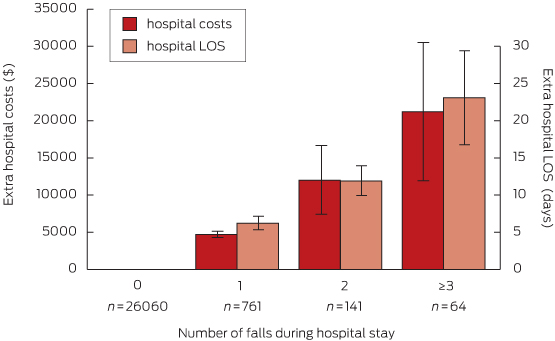
Data for hospital LOS and costs for the total cohort and by group are summarised in Box 4. The total hospital costs of fallers in this dataset were $9.8 million, with $6.4 million attributable to non-injured fallers and $3.4 million to injured fallers. After adjustment for age, sex, cognitive impairment, admission type, comorbidity, history of falls on admission and clustering by hospital, the mean LOS for fallers was 8 days longer (95% CI, 5.8–10.4; P < 0.001) than for non-fallers, and on average they incurred $6669 more in hospital costs (95% CI, $3888–$9450; P < 0.001) (model 1a, Box 5). Each additional fall was associated with a longer LOS and additional hospital costs; the LOS for patients who experienced three or more falls was estimated as being 23 days longer (95% CI, 10.7–35.4; P = 0.003) than for non-fallers, and they incurred more than $21 000 in additional hospital costs (95% CI, $3035–$39 355; P < 0.001) (model 1b, Box 6).

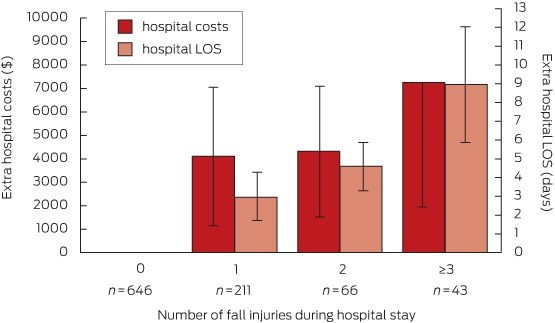
Within the cohort of fallers, the mean LOS for an injured faller was 4 days longer (95% CI, 1.8–6.6; P = 0.001) than for a faller without injury. Consistent with our other findings, mean hospital costs were also higher (by $4727; 95% CI, −$568 to $10 022; P = 0.08), but the difference was not statistically significant (model 2a, Box 5). Each additional fall injury was associated with increased LOS and additional hospital costs (model 2b, Box 7); patients who experienced three or more in-hospital fall injuries were estimated to have a mean increase in LOS of 9 days (95% CI, 2.8–15.1; P = 0.004) compared with a faller without injury, and incurred more than $7000 in extra hospital costs (95% CI, −$3126 to $17 636; P = 0.171) (Box 7). There were no statistically significant differences in hospital LOS or costs associated with the severity of a fall-related injury (189 hospital admissions with mild injury, 89 with moderate injury, 35 with severe injury; model 2c). Results from models 1b, 2b and 2c are summarised in Appendix 2.

The cross-validation analyses of the linear regression using generalised linear models and log transformation of LOS and costs (Appendix 3) did not alter our conclusions.

Sensitivity analyses

Fallers who did not sustain injuries were estimated to have a mean increase in LOS of 7 days (95% CI, 5.1–8.7; P < 0.001) compared with non-fallers, and incurred mean additional hospital costs of $5395 (95% CI, $3788–$7002, P < 0.001). Injured fallers were estimated to have a mean increase of LOS of 11 days (95% CI, 5.1–8.7; P < 0.001) compared with non-fallers, and incurred mean additional hospital costs of $9917 (95% CI, $3273–$16 561; P = 0.003). Additional sensitivity analyses were undertaken to examine the robustness of study estimates by individually excluding each hospital from the analysis, and by excluding 78 patient admissions that appeared to be outliers with respect to hospital LOS or costs. There were no appreciable differences in the excess LOS or costs calculated by these analyses (results available from authors on request).

Discussion

This study found that in-hospital falls remain highly prevalent, with 3.6% of all patient admissions resulting in at least one fall, a third of which caused a fall injury. They are a significant burden on hospital resources because of the resulting increases in hospital LOS and costs, with patients who experience an in-hospital fall having nearly twice the LOS and costs of non-fallers. Our study shows that more than half of the additional costs associated with a fall injury can be attributed to the fall itself, not the injury.

The increase in resource burden associated with an in-hospital fall, whether the patient sustains an injury or not, may be caused by changes in the patient’s care pathway and discharge planning. Previous studies have found that a fall (regardless of injury) will affect the patient’s confidence and independence,17 and therefore influences their rate of recovery and plan to leave hospital. Best practice guidelines recommend that patients who have a fall be provided with strategies that minimise the risk of subsequent falls and an assessment of safety and readiness for discharge home.18,19 As a result, delivery of guideline-based care is likely to influence the overall hospital LOS, regardless of injury, and thus their use of hospital resources.

However, as our study was observational, it is possible that a fall might be the consequence of a patient’s longer hospital stay rather than its cause. Patients at risk of falling in the acute hospital setting are typically acutely unwell, often have multiple comorbidities, and take several medications. A fall may therefore reflect deterioration in an individual’s health and function rather than cause it. Further exploration of temporal trends in the occurrence of falls and the care pathway of patients following a fall event are warranted.

Some limitations should be considered when interpreting our findings. While we adjusted our analyses for potential confounding factors, unmeasured characteristics may have influenced hospital cost and LOS outcomes. These include differences in patient management across wards, severity of illness and acuity of care. There are also limitations associated with analysis of routinely collected hospital data for the assessment of health conditions,20 which may have resulted in the undercoding of confounding factors. However, the coding quality of ICD-10-AM in Australia has been found to be good to excellent for many diagnostic codes and comorbidities.21

The use of hospital costing data also poses challenges. While analysis of clinical costing data is a powerful research tool and aims to preserve information about variability in individual patient resource use,22 clinical costing standards are relatively new for Australian public hospitals. We observed some variability in the completeness and quality of the available costing data, and hospitals with incomplete or poor-quality costing data were removed from our costing analysis, resulting in a sample that included about half of the total study cohort. Finally, the results from our study only incorporated costs of hospitalisation from the acute hospital perspective, potentially providing a more conservative estimate of the overall resource burden.

Fall rates in the acute hospital setting remain unacceptably high and are clearly associated with longer hospital patient stays and higher hospital costs. The resource burden of in-hospital falls for the Australian hospital system is considerable. Our findings highlight the fact that falls prevention programs in the acute hospital setting need to focus not only on the minimisation of harm resulting from falls, but also on the prevention of all falls. In the absence of evidence from randomised control trials that supports the effectiveness of any single falls prevention strategy in the acute hospital setting,23 the challenge remains to develop innovative ways to prevent falls in hospital and to reduce the additional resource burden associated with these events. Our findings have important financial implications for hospitals in light of an ageing population and the growth in the burden of disease, and the complexity of patients within a health care system facing major cost constraints.

Box 1 –
Fall injury classification, according to Morse12

  • No injury: No physical damage (observed or documented) as a result of the fall
  • Mild injury: An injury (such as a bruise, swelling, abrasion, laceration or skin tear) that does not require medical treatment other than simple analgesia, such as paracetamol
  • Moderate fall injury: Dislocation, sprain and/or an injury that requires medical or surgical treatment
  • Major fall injury: Any fracture or head injury (open or closed), including subdural haematoma

Box 2 –
Linear regression models for analysis of additional hospital length of stay (LOS) and costs associated with a fall or fall-related injury

Model

Definition


1a

Additional hospital costs and LOS of patients who experience at least one in-hospital fall (fallers), compared with those who do not (non-fallers)

1b

Additional hospital costs and LOS of each additional in-hospital fall (1, 2, ≥ 3 falls) compared with non-fallers

2a

Additional hospital costs and LOS of patients who experience at least one in-hospital fall injury (injured fallers), compared with those who fell at least once but were not injured (non-injured fallers)

2b

Additional hospital costs and LOS of each additional in-hospital fall injury (1, 2, ≥ 3 injuries) compared with non-injured fallers

2c

Incremental hospital costs and LOS associated with the type of fall injury (based on the injury classification: mild, moderate and major fall injuries) compared with non-injured fallers


Box 3 –
Characteristics of the study cohort

Characteristic

All hospital admissions (n = 27 026)

Hospital admissions by faller status


Hospital admissions by injury status


Faller (n = 966)

Non-faller (n = 26 060)

P

Injured faller (n = 313)

Non-injured faller (n = 653)

P


Age

< 0.001

0.064

< 55 years

8332 (30.8%)

120 (12.4%)

8212 (31.5%)

32 (10.2%)

88 (13.5%)

55–69 years

6626 (24.5%)

188 (19.4%)

6438 (24.7%)

51 (16.3%)

137 (21.0%)

70–84 years

8730 (32.3%)

451 (46.7%)

8279 (31.8%)

152 (48.6%)

299 (45.8%)

≥ 85 years

3338 (12.4%)

207 (21.4%)

3131 (12.0%)

78 (24.9%)

129 (19.8%)

Sex (female)

12 997 (48.1%)

400 (41.4%)

12 597 (48.3%)

< 0.001

112 (35.8%)

288 (44.1%)

0.055

Admission type

< 0.001

0.338

Medical non-emergency

2421 (9.0%)

105 (10.9%)

2316 (8.9%)

34 (10.9%)

71 (10.9%)

Medical emergency

16 232 (60.1%)

637 (65.9%)

15 595 (59.8%)

207 (66.1%)

430 (65.8%)

Surgical non-emergency

4585 (17.0%)

122 (12.6%)

4501 (17.3%)

19 (6.1%)

65 (10.0%)

Surgical emergency

3355 (12.4%)

84 (8.7%)

3233 (12.4%)

45 (14.4%)

77 (11.8%)

Not recorded

433 (1.6%)

18 (1.9%)

415 (1.6%)

8 (2.6%)

10 (1.5%)

Admitted from nursing home

166 (0.6%)

13 (1.3)

153 (0.6%)

0.001

3 (1.0%)

10 (1.5%)

0.267

Reason for hospital admission

Injuries

3852 (14.3%)

114 (11.8%)

3738 (14.3%)

< 0.001

37 (11.8%)

77 (11.8%)

0.602

Digestive system diseases

3512 (13.0%)

71 (7.3%)

3441 (13.2%)

0.042

31 (9.9%)

40 (6.1%)

0.130

Circulatory system diseases

3150 (11.7%)

115 (11.9%)

3035 (11.6%)

0.907

25 (8.0%)

90 (13.8%)

0.008

Respiratory system diseases

3051 (11.3%)

107 (11.1%)

2944 (11.3%)

0.706

36 (11.5%)

71 (10.9%)

0.896

Cancer

3029 (11.2%)

152 (15.7%)

2877 (11.0%)

< 0.001

49 (15.7%)

103 (15.8%)

0.533

Genitourinary system diseases

1867 (6.9%)

48 (5.0%)

1819 (7.0%)

0.535

19 (6.1%)

29 (4.4%)

0.062

Musculoskeletal and connective tissues disease

1309 (4.8%)

41 (4.2%)

1268 (4.9%)

0.027

11 (3.5%)

30 (4.6%)

0.338

Endocrine, nutritional, metabolic diseases

989 (3.7%)

57 (5.9%)

932 (3.6%)

0.010

20 (6.4%)

37 (5.7%)

0.440

Infectious and parasitic diseases

978 (3.6%)

40 (4.1%)

938 (3.6%)

0.755

15 (4.8%)

25 (3.8%)

0.775

Mental and behavioural disorders

536 (2.0%)

59 (6.1%)

477 (1.8%)

< 0.001

17 (5.4%)

42 (6.4%)

0.587

Other

4753 (17.6%)

162 (16.8%)

4591 (17.6%)

0.584

53 (16.9%)

109 (16.7%)

0.782

Presence of cognitive impairment during admission*

1882 (7.0%)

270 (28.0%)

1612 (6.2%)

< 0.001

93 (29.7%)

177 (27.1%)

0.061

Total number of comorbidities on admission, mean (SD)

1.8 (2.7)

2.5 (1.5)

1.5 (1.8)

< 0.001

2.7 (1.8)

2.4 (1.8)

0.532

History of falls on admission

2042 (7.6%)

133 (13.8%)

1961 (7.5%)

0.001

53 (16.9%)

80 (12.3%)

0.008


∗ICD-10-AM codes for delirium and dementia: F050, F051, F058, F059, F104, F106, F114, F124, F134, F144, F154, F164, F174, F184, F194, F430, F00-F03, G30, G311, G309. †Elixhauser comorbidity method.14 ‡ICD-10-AM codes for history of falls: W00, W01-10, W13-15 W17-19.

Box 4 –
Hospital length of stay and hospital costs for patient hospital admissions

Hospital length of stay

All hospital admissions (n = 27 026)


Hospital admissions with a fall (n = 966)


Hospital admissions without a fall (n = 26 060)

Hospital admissions with a fall (n = 966)

Admissions without a fall injury (n = 653)

Admissions with a fall injury (n = 313)


Mean hospital length of stay, days (SD)

7.9 (8.5)

19.5 (17.6)

18.0 (15.0)

22.5 (21.9)

Median hospital length of stay, days (IQR)

5 (3–9)

14 (9–24)

14 (8–23)

17 (9–27)

Hospital costs

All hospital admissions (n = 13 489)


Hospital admissions with a fall (n = 533)


Hospital admissions without a fall (n = 12 956)

Hospital admissions with a fall (n = 533)

Admissions without a fall injury (n = 376)

Admissions with a fall injury (n = 157)


Mean hospital costs, $ (SD)

9368 (12 572)

19 289 (21 712)

17 897 (17 317)

22 623 (29 511)

Median hospital costs, $ (IQR)

6038 (3658–10 585)

12 833 (8314–21 261)

12 821 (8440–20 904)

13 563 (7850–21 500)


IQR = interquartile range.

Box 5 –
Adjusted increased hospital use by patients with an in-hospital fall or fall injury (multivariate linear regression models)

Mean hospital length of stay, days (95% CI)

P

Mean hospital costs, $ (95% CI)

P


Faller (model 1a)

8.1 (5.8 to 10.4)

< 0.001

6669 (3888 to 9450)

< 0.001

Sex (female)

0.4 (0.2 to 0.6)

566 (41 to 1092)

0.035

Age

< 55 years

1.0

< 0.001

1.0

55–69 years

1.1 (0.6 to 1.6)

< 0.001

839 (−1575 to 3253)

0.496

70–84 years

1.6 (0.7 to 2.4)

< 0.001

1,698 (−856 to 4251)

0.193

≥ 85 years

2.0 (0.9 to 3.0)

< 0.001

795 (−1353 to 2944)

0.468

Cognitive impairment

4.8 (3.4 to 6.2)

< 0.001

5229 (943 to 9515)

0.017

Admission type

Medical non-emergency

1.0

1.0

Medical emergency

0.9 (−0.3 to 2.2)

0.146

906 (−524 to 2337)

0.214

Surgical non-emergency

1.7 (0.2 to 3.2)

0.023

7,330 (3730 to 10 930)

< 0.001

Surgical emergency

6.1 (3.9 to 8.2)

< 0.001

12 407 (1487 to 23 327)

0.026

Number of comorbidities

2.1 (1.5 to 2.6)

< 0.001

2605 (1564 to 3647)

< 0.001

Admitted from nursing home

−0.3 (−2.7 to 2.2)

0.831

4549 (−2697 to 11 794)

0.219

History of falls on admission

0.5 (−1.1 to 2.0)

0.567

−549 (−2490 to 1393)

0.580

Injured faller (model 2a)

4.2 (1.8 to 6.6)

0.001

4727 (−568 to 10 022)

0.080

Sex (female)

1.0 (−0.8 to 2.8)

0.278

519 (−1580 to 2618)

0.628

Age

< 55 years

1.0

0.784

1.0

55–69 years

−0.4 (−3.0 to 2.2)

0.556

−7095 (−20 182 to 5992)

0.288

70–84 years

−0.9 (−3.9 to 2.1)

0.111

−5772 (−17 208 to 5665)

0.323

≥ 85 years

−1.3 (−2.9 to 0.3)

<0.001

−8436 (−20 759 to 3887)

0.180

Cognitive impairment

5.3 (2.6 to 8.0)

6865 (1575 to 12 155)

0.011

Admission type

Medical non-emergency

1.0

1.0

Medical emergency

−0.7 (−3.7 to 2.4)

0.664

−973 (−3103 to 1157)

0.371

Surgical non-emergency

9.7 (2.9 to 16.5)

0.005

11 272 (2769 to 19 774)

0.009

Surgical emergency

10.3 (5.2 to 15.2)

< 0.001

19 706 (1530 to 37 881)

0.034

Number of comorbidities

2.7 (1.3 to 4.2)

< 0.001

3065 (1366 to 4763)

< 0.001

Admitted from nursing home

−4.0 (−13.2 to 5.3)

0.404

6953 (−14 912 to 28 819)

0.533

History of falls on admission

−0.4 (−2.1 to 1.3)

0.659

−3778 (−7787 to 231)

0.065


∗The intraclass correlation coefficient was 0.002 for the number of falls (95% CI, 0.000–0.005) and 0.001 for number of fall injuries (95% CI, 0.000–0.003). †Elixhauser comorbidity method.14

Box 6 –
Adjusted increases in hospital length of stay (LOS) and costs associated with each additional fall (total study cohort)


Data expressed as means ± standard errors.

Box 7 –
Adjusted increases in hospital length of stay (LOS) and costs associated with each additional fall injury (faller cohort only)


Data expressed as means ± standard errors.

News briefs

The BMJ questions e-cigarettes endorsement

The BMJ has questioned the decision by Public Health England — (mission statement: “We protect and improve the nation’s health and wellbeing, and reduce health inequalities”) — to endorse the use of e-cigarettes as an aid to quitting smoking. In a report released at the end of August PHE concluded that e-cigs were “95% less harmful” than conventional cigarettes and described them as a potential “game changer” in tobacco control. In The BMJ Professor Martin McKee and Professor Simon Capewell said the available evidence, including a recent Cochrane review, did not show clearly that e-cigs were as effective as established quitting aids. “We might also expect that the prominently featured ‘95% less harmful’ figure was based on a detailed review of evidence, supplemented by modelling”, wrote McKee and Capewell. “In fact, it comes from a single [sponsored] meeting of 12 people.” The sponsors included a CEO with previous funding from British American Tobacco. One of the 12 was a chief scientific advisor with declared funding from an e-cigarette manufacturer, and Philip Morris International. “None of these links or limitations are discussed in the PHE report”, McKee and Capewell wrote.

Dramatic rise in antibiotic use globally

Nature reports that “antibiotic use is growing steadily worldwide, driven mainly by rising demand in low- and middle-income countries”, citing the latest report from the Center for Disease Dynamics, Economics and Policy. The organisation used a review of data from scientific literature, and national and regional surveillance systems to calculate and map the rate of antibiotic resistance for 12 types of bacteria in 39 countries, and trends in antibiotic use in 69 countries over the past 10 years or longer. “Global antibiotic consumption grew by 30% between 2000 and 2010. This growth is driven mostly by countries such as South Africa and India, where antibiotics are widely available over the counter and sanitation in some areas is poor.” The report also found that the use of antibiotics in livestock is growing worldwide, particularly in China, which used about 15 000 tonnes of antibiotics for this purpose in 2010, and is projected to double its consumption by 2030.

Child mortality under six million for first time

A new World Health Organization report says deaths among children aged 5 years and under worldwide have more than halved over the last 25 years, falling from 12.7 million a year in 1990 to 5.9 million in 2015. “While progress has been substantial, a 53% drop in child mortality is far short of the Millennium Development Goal, where countries agreed to reduce child mortality between 1990 and 2015 by two-thirds.” Around 16 000 children under 5 still die every day, most from diseases that are readily preventable or treatable, says the report. Around 50% of global deaths among the under 5s occur in sub-Saharan Africa, while 30% occur in southern Asia. Approximately 45% of deaths among the under 5s occur in the first 28 days of life. One million infants die on the day they are born, and nearly 2 million during the first week following birth. Leading causes of death in this group include complications during labour, premature birth, pneumonia, sepsis, diarrhea and malaria. Most of the remaining deaths among the under 5s are tied to undernutrition.

Static electricity next frontline in malaria control

Dutch researchers have come up with a way of improving the efficacy of mosquito nets using static electricity, according to a report in The Economist. With the WHO reporting a 60% drop in deaths caused by malaria since 2000, In2Care, a Dutch mosquito-control firm, is finding a way to deliver insecticides embedded in mosquito nets more effectively to the target insect. “Current mosquito nets are woven from fibres impregnated throughout with an insecticide”, The Economist reports. “This permits them to be washed and used for years without loss of potency. But it also means this potency is not as great as it could be, because the insecticide is released only slowly by the fibres. Using static electricity, by contrast, means all of the insecticide is held on the surface of a net’s fibres. Much larger doses can thus be transferred to an insect which blunders into the net. In addition, a wide range of insecticides — and even, possibly, the spores of a fungus harmless to people but lethal to mosquitoes — can be applied to the fibres.”

How changes to the Medicare Benefits Schedule could improve the practice of cardiology and save taxpayer money

The Australian Medicare system is a government-funded fee-for-service system that is highly regarded by the general public. A major advantage of the system is that low-income non-insured patients have ready access to approved ambulatory medical services at little or no cost to them, with public inhospital care provided at no charge. However, a disadvantage is the potential for over servicing. This may occur when new technology or new knowledge lessens or eliminates the indications for a test, without such a development being reflected by a change in the criteria for the particular Medicare Benefits Schedule (MBS) item number. In these circumstances, a medical practitioner may disregard advances in the medical evidence base and continue to practice in the same way, particularly if it is financially advantageous to do so. The examples we discuss in this article reflect this phenomenon. Computed tomography coronary angiography (CTCA), a new, safer and much less expensive technology, should replace invasive coronary angiography (ICA) for the diagnosis of coronary artery disease (CAD), but based on Medicare item reports for 2010–2014,1 this is happening only slowly. Measurement of the fractional flow reserve (FFR) clearly improves the practice of percutaneous coronary intervention (PCI) and saves both money and lives; however, the uptake in Australia has been slow.1 A nuclear stress test has a high radiation burden and is 3.4 times more expensive than a stress echocardiogram,2 yet under the current MBS system it can be ordered by any medical practitioner who may or may not be aware of the cost or the radiation risk.

Invasive coronary angiography

ICA is an expensive procedure ($5187–$6289 per procedure; Appendix 1), with substantial cost to the taxpayer (Box 1). It carries a small risk of serious complications and a radiation burden (5–7 mSv).3 It is a guideline-recommended investigation for patients presenting with troponin-positive acute coronary syndrome.4 In these circumstances, ICA and PCI, if necessary, should be performed by an interventional cardiologist at the same sitting.

ICA is also indicated in symptomatic patients with known stable CAD or with a high probability of CAD who have evidence of myocardial ischaemia of sufficient severity to justify revascularisation with PCI or coronary artery bypass grafting.5 In these circumstances, initial ICA is often performed by a non-interventional cardiologist, and a second ICA and a PCI, if indicated, is then carried out by an interventional cardiologist. This practice is inefficient; the patient and the Medicare system will be billed for two ICAs and a PCI, whereas if the initial ICA had been performed by an interventional cardiologist, only one ICA (and one PCI) would have been charged. Further, in most cases, the decision of a non-interventional cardiologist to refer a patient for PCI after the baseline ICA will be made on visual (anatomical) assessment of the coronary lesion(s), whereas it should be guided by both anatomical and functional assessment.6 The diagnostic accuracy of ICA based on diameter stenosis alone to predict functionally significant coronary artery stenosis (ie, lesions causing ischaemia) is poor.7,8 In the FAME (Fractional flow reserve versus Angiography for Multivessel Evaluation) study, 35% and 80% of coronary lesions seen on ICA with diameter stenosis between 50%–70% and 70%–90%, respectively, were functionally significant by FFR measurement.8 The implication of these findings is that if a patient with stable CAD undergoes ICA for the purpose of assessing suitability for revascularisation, the operator should be capable of performing FFR measurement. As FFR measurement involves instrumentation of the coronary artery with a pressure wire, interventional training is required for its safe performance. This lends further support that ICA is best performed by an interventional cardiologist.

ICA is no longer an appropriate test for the diagnosis of CAD, because it is associated with a low rate of obstructive CAD warranting intervention, even when preceded by an abnormal stress test result.9 It accurately examines the lumen of the coronary artery but does not detect non-obstructive atherosclerotic lesions in the coronary wall that could be a nidus for future coronary events.10 That is, a “normal” ICA finding does not always exclude coronary atherosclerosis.

We suggest that the item numbers for ICA should only be payable if the procedure is performed by an accredited interventional cardiologist in a hospital with accredited PCI facilities.

In cardiology, there is already a precedent for a procedural item number to be available only to an accredited cardiologist. For example, the item number for extraction of a permanent pacemaker lead is only available to cardiologists accredited for that procedure on the advice of the Cardiac Society for Australia and New Zealand. To our knowledge, all public and private hospitals performing PCI have an accreditation process to allow cardiologists to carry out the procedure in their hospital. For new applications, accreditation approval in these hospitals requires evidence that the candidate has undergone specialised training in interventional cardiology and is regarded as competent by his or her supervisors. We suggest that all interventional cardiologists currently accredited to perform PCI be allowed to charge the item numbers for ICA, and that new applications for accreditation be vetted by the Cardiac Society for Australia and New Zealand.

Operator compliance with the indications for ICA could be monitored by examination of an individual cardiologist’s Medicare statistics or, alternatively, by a national cardiac procedures registry. For example, if ICA was only being performed in the setting of troponin-positive acute coronary syndrome or for patients with known CAD and objective evidence of ischaemia not sufficiently controlled with medical therapy, one would expect most patients to require a revascularisation procedure such as PCI or coronary artery bypass grafting. On this basis, the ratio of ICA to revascularisation should be at least less than 2.0 : 1 and preferably in the order of 1.5 : 1. If an individual cardiologist’s statistics fall well outside this range (eg, greater than 2 SDs from that of his or her peers), that cardiologist could be asked to justify the discrepancy.

Computed tomography coronary angiography

Compared with ICA, CTCA is a safer, less invasive and less expensive (the cost to the taxpayer is $622 per angiogram) outpatient investigation and carries a lower radiation burden. The costs of equipping and running a CTCA service in terms of equipment and personnel are far less than those for a cardiac catheterisation laboratory. In regional hospitals without cardiac catheterisation and PCI facilities, the presence and appropriate use of CTCA would allow many patients to be treated locally without the need for transfer to larger centres.

CTCA should be considered as a logical first-line investigation in patients with suspected CAD.1113 There are three possible outcomes to a CTCA investigation. First, the angiogram may show completely normal results. In such a patient, the likelihood of a coronary event occurring within the next 5 years is extremely low.14,15 Second, the angiogram may show non-obstructive coronary atherosclerosis. In this instance, the patient’s symptoms are unlikely to be caused by myocardial ischaemia. Nevertheless, such patients are at increased risk of future cardiovascular events and require lifestyle advice and possibly anti-atherosclerotic therapy.14,16,17 Third, the angiogram may show obstructive intramural coronary atherosclerotic lesions (or non-evaluable segments as a result of heavy calcifications). Symptomatic patients with these lesions require lifelong anti-atherosclerotic therapy and may benefit from a stress test to determine the presence of ischaemia. CTCA alone is of little or no diagnostic value in patients with pre-existing CAD, because with current technology, routine CTCA is not capable of reliably detecting ischaemia.18

We suggest that the item number for CTCA be payable only if performed in patients without known CAD. For patients whose initial CTCA results are normal, a second CTCA investigation should only be rebatable if it is performed at least 5 years after the first. The imposition of these restrictions would undoubtedly reduce over servicing and help stem the dramatic rise in the use of CTCA.

Stress testing

Stress testing (electrocardiogram based, echocardiogram based or nuclear based) is the non-invasive test of choice for detection of myocardial ischaemia but is a less suitable test for the diagnosis of CAD.19 A standard electrocardiogram stress test is less accurate than either a nuclear stress test or a stress echocardiogram to determine the site and extent of ischaemia. A stress echocardiogram and a nuclear stress test have similar sensitivity for detecting ischaemia but the former has a higher specificity.20 Stress echocardiography is not associated with any radiation exposure but may be technically difficult in patients with unfavourable body habitus. On the other hand, a stress nuclear test is 3.4 times more expensive ($756 v $222) and carries an average radiation burden of 9–11 mSv.3 For these reasons, we suggest that the item number for a nuclear stress test be payable only if ordered by a physician and only if a stress echocardiogram is considered unsuitable for technical reasons.

Percutaneous coronary intervention

ICA with a view to PCI at the culprit lesion, if technically suitable, is a guideline recommendation for patients with acute coronary syndrome.4 In stable CAD, the benefit from PCI with optimal medical therapy is less certain compared with medical therapy alone.21 Furthermore, stenting of non-ischaemic coronary lesions leads to higher rates of mortality and myocardial infarction.22 A coronary lesion can be assumed to be causing ischaemia only if there is > 90% stenosis in a major coronary artery or if it is a single lesion in a coronary vessel supplying an area of myocardium identified as ischaemic on stress testing. All other coronary lesions should not be stented in stable CAD unless the FFR is less than 0.8. Use of FFR in this manner has been shown to reduce stent insertions, improve outcomes and lower health costs.23,24 According to Medicare item reports for 2013–2014,1 only 16% of cases of PCI were associated with FFR. The implication of this finding is that, in Australia, many patients must be undergoing PCI procedures that are potentially detrimental to their health.

We suggest separate MBS item numbers for PCI for troponin-positive acute coronary syndrome and for PCI for stable CAD, thus allowing easier evaluation of the Medicare statistics of an individual practitioner. The item number for PCI for stable CAD should only be payable if one of three conditions is satisfied: (i) a stenosis >90% in a coronary vessel >2 mm in diameter; (ii) a single lesion in a vessel supplying an area of myocardium identified as ischaemic on stress testing; or (iii) a coronary lesion associated with an FFR less than 0.8.

Overall savings resulting from our proposed changes

The overall savings resulting from these changes are summarised in Box 2. Medicare statistics along with data from the Australian Commission on Safety and Quality in Health Care25 were used to calculate the ratio of ICA to revascularisation and the cost to the taxpayer of unnecessary ICA (defined as in excess of a ratio of 1.5 : 1; Appendix 2). Applying this ratio to the four patient groups discussed, taxpayers could have saved $233.5 million and private health insurance companies $139.8 million in 2013–2014.

If our suggested changes to PCI were to occur, the annual savings to the Australian health budget would be in the order of $4 million.24 Changes for CTCA would be cost neutral in the short term but would save costs in the long term (Appendix 2).

In 2013–2014, 77 564 nuclear stress tests were charged to Medicare (cost per test, $756). It is likely that at least 75% of these patients could have had a less expensive stress echocardiogram (cost per test, $222) as an alternative. Doing so would have saved over $30 million of the Medicare budget.

We believe that these relatively simple changes to the MBS would improve the practice of cardiology (Box 3) and result in substantial savings to the health budget (Box 2). Undoubtedly, some cardiologists will consider the suggested changes to be an unwelcome interference with their practice. The counter argument is that as funders of Medicare, the government has a right and a duty to spend public money prudently.

In 2013–2014, the ratio of ICA to revascularisation was substantially higher in the private compared with the public system (3.1 v 2.3; Appendix 2). The likely explanation relates to the effect of fee-for-service on the provision of ICA.

A potential disadvantage of performing PCI at the same sitting as the initial ICA is that the patient will be denied the opportunity for surgical consultation. However, in light of recent evidence indicating the clear superiority of coronary artery bypass grafting over PCI for patients with complex multivessel disease or with diabetes with multivessel disease,26,27 we believe the need for multidisciplinary discussion to determine the best revascularisation option will be infrequent. We consider our recommended ratio of ICA to revascularisation of 1.5 : 1 or less to be sufficiently elastic to accommodate this possibility without compromising patient care.

In summary, we believe these relatively simple changes to the MBS would result in improved evidence-based cardiology practice and substantial savings to the health budget in an ever-increasingly constrained fiscal climate.


Cost to the taxpayer of unnecessary invasive coronary angiography (ICA), 2013–2014

ICA to revascularisation ratio

No. of unnecessary cases

Cost per unnecessary case

Cost per year


Public inpatient

2.3 : 1

23 060

$5773

$133.13m

Private in public

2.7 : 1

2986

$4964

$14.82m

Private inpatient

3.1 : 1

38 259

$2199

$84.13m

Non-insured outpatient

2.4 : 1

1871

$759

$1.42m

Total cost

$233.5m


How much money could be saved?

Measure

Potential annual savings


Reducing invasive coronary angiography to revascularisation ratio to 1.5 : 1

$233.5m

Limitations to computed tomography coronary angiography

Cost neutral

Reducing nuclear stress tests

$30.1m

More use of fractional flow reserve

$4.0m

Total

$267.6m


How our proposed changes to the Medicare Benefits Schedule could improve cardiology practice

  • More judicious use of invasive coronary angiography = less complications, less radiation exposure, less waste of catheter laboratory resources.
  • More judicious use of computed tomography coronary angiography = earlier diagnosis of coronary artery disease, better prognostic assessment, lifestyle modifications and medical therapy where appropriate.
  • More judicious use of nuclear stress test = less radiation burden.
  • Greater use of fractional flow reserve-guided percutaneous coronary intervention = less inappropriate percutaneous coronary intervention and less myocardial infarction and death.

Lost productive life years caused by chronic conditions in Australians aged 45–64 years, 2010–2030

Globally, there has been a substantial increase in the number of years lived with disability (YLDs) over the past 20 years. The YLDs for 1160 sequelae of 289 diseases and injuries were estimated as part of the 2010 Global Burden of Disease study: global YLDs from all causes had increased from 583 million in 1990 to 777 million in 2010.1 The main contributors to YLDs were mental and behavioural disorders, musculoskeletal disorders, and diabetes or endocrine diseases. While the Global Burden of Disease study measured YLDs at particular time points, governments have become increasingly concerned by lost productive life years (PLYs) caused by chronic disease at particular time points. We define PLYs as the loss of productivity that results from individuals not being able to participate in the labour force because of their chronic conditions. Few studies have undertaken a thorough assessment of the impact of chronic disease on labour productivity, and most have focused only on the burden of single diseases. Recent studies have shown that chronic disease can negatively affect the labour market and related outcomes, such as reduced income, greater welfare dependency and earlier retirement.2

The significant costs of premature retirement caused by chronic disease have been highlighted for most Organisation for Economic Co-operation and Development (OECD) countries.3 Premature retirement has attracted considerable attention in Australia, where unemployment is low (5.8% in June 2014) compared with other OECD countries4 and there are substantial labour shortages in a number of industries. The Australian Treasury maintains that Australia’s financial position can only be improved by increasing productivity, population growth and labour force participation.5 Having a large number of people excluded from the labour force by ill health is likely to constrain economic growth.

The impacts of an ageing population and labour shortages on a country’s fiscal position have featured heavily in recent reports by supranational organisations, such as the OECD and the World Health Organization,3,6 and national governments, including the Australian Government.5 A range of policies have been adopted by the six OECD countries participating in the Workforce Aging in the New Economy (WANE) project (including Australia) to encourage the labour force participation of older workers,7 including abolishing mandatory retirement; changes to national pension and welfare systems, and disability and employment insurance; active labour-market policies; and promoting phased or gradual retirements.

If chronic conditions are one of the main barriers to labour force participation, financial incentives alone may not be sufficient to maximise the contribution of older workers. Studies from the United States and Canada have shown that employment rates among older persons with musculoskeletal conditions,8 mental illness9 and other chronic conditions are lower than those among older people without these conditions.10 Similar studies from Australia and New Zealand have found that back pain,11 arthritis,12 mental illness,13 type 2 diabetes14 and cardiovascular disease15 are linked with lower labour force participation. With an ageing population, there is a risk that chronic conditions will further limit labour force capacity.

The aims of this study were to estimate (1) the PLYs lost to chronic conditions in Australians aged 45–64 years for each 5-year period from 2010 to 2030; and (2) the impact of these lost PLYs in terms of lost gross domestic product (GDP). The effects of population ageing, population growth, labour force trends and chronic disease trends are also captured in these estimates.

Methods

Data

We analysed output data from a microsimulation model called Health&WealthMOD2030,16 which is Australia’s first microsimulation model of the impact on long-term productivity over a 20-year period (2010–2030) of chronic disease and disability in the population aged 45–64 years.

The base population consists of unit record data from the cross-sectional Australian Bureau of Statistics (ABS) Surveys of Disability, Ageing and Carers (SDAC) 2003 and 2009.17,18 The records of persons aged 45–64 years and members of their family income unit were extracted. The records include data on demographic variables (age, sex, family type); socioeconomic variables (education, welfare payments); labour force variables (labour force participation, retirement); and health variables (chronic conditions, type and extent of disability).

The Australian Population and Policy Simulation Model (APPSIM)19 was used to age the SDAC data to represent the expected population in 2030. APPSIM is a dynamic population microsimulation model developed by the National Centre for Social and Economic Modelling (NATSEM) at the University of Canberra in collaboration with 12 Australian Government departments. APPSIM is based on a 1% sample from the 2001 ABS Census of Housing and Population (the ABS Household Sample File Australia 2001).19 It simulates all major lifetime events experienced by Australians on the basis of the probability of their occurring to people in Australia. Simulated snapshots of the Australian population from 2010 to 2030 generated by APPSIM were used in this study.

To account for epidemiological trends in chronic conditions, we applied the same trends in incidence that were used in the 2003 Australian Burden of Disease and Injury Study,16,20 which projected trends for the period 2003–2023, after which it was assumed that time rates would stabilise. We calculated proportional changes in the prevalence of chronic conditions and applied these to the corresponding diseases in the SDAC data, aggregated into the following categories: stroke, cancer (almost stable in men and women), ischaemic heart disease (decreasing rate in men and women), type 2 diabetes (increasing rate in men and women) and chronic obstructive pulmonary disease (stable in men; increasing rate in women). In the absence of data about trends, the rates for all other conditions were assumed to remain stable. Based on proportional changes, the prevalence of chronic conditions in Australians aged 45–64 years was projected for 2010 and 2030 by 5-year age groups and sex.

To account for population growth and trends in labour force participation in our PLY projections, we used 2013–2014 population and labour force projections provided by the Australian Treasury. We extracted population projections and projected full-time and part-time employment rates to 2030 for Australians aged 45–64 years by 5-year age groups and sex.16

The SDAC 2003 and 2009 data were separately reweighted to match the 2010 Australian population according to the ABS GREGWT reweighting algorithm,16 which takes into account key demographic and other changes in the population between 2003 and 2009. After reweighting, the datasets were combined and the weights halved so that the total weighted population in this new dataset matched the 2010 Australian population. A diagram of how the tools and datasets (both the source data and the datasets assembled thereafter) were used in this study is included in Appendix 1.

Our use of ABS SDAC 2003 and 2009 data was approved by the ABS Microdata Review Panel.

Labour force participation and chronic conditions

In the SDAC 2003 and 2009 surveys, respondents were asked to nominate their current labour force status, with the following options:

  • Employed working full-time;

  • Employed working part-time;

  • Unemployed looking for full-time work;

  • Unemployed looking for part-time work;

  • Not in the labour force; and

  • Not applicable.

For those who were not in the labour force, the main reason for not looking for work was also sought; in particular, respondents were asked whether they were out of the labour force because of their “own ill health or disability”. Respondents were also asked whether they had a long-term condition and, if so, to nominate the type of condition they had from a list of 80 conditions and injuries. Those identified as being out of the labour force due to ill health or disability were classified in this study as having lost PLYs because of a chronic condition.17,18

Statistical analysis

Outputs from Health&WealthMOD2030 were used to generate descriptive statistics of the relationship between chronic disease, PLYs lost and labour force participation of older workers in 2010, 2015, 2020, 2025 and 2030, by age group and sex.

We analysed the expected growth in the number of people aged 45–64 years who would lose PLYs (and the growth in the number of persons employed with and without chronic disease) at each of the five time points. Projected changes were driven by population growth, population ageing, chronic condition trends and labour force trends (by age group and sex). The contributions of each driver to the number of workers aged 45–64 years in each of the labour force groups to 2030 were disaggregated. All analyses were conducted in SAS V9.3 (SAS Institute).

GDP equation

The impact of PLYs lost to chronic disease in the 45–64-year-old age group on national GDP was calculated using the GDP formula of the Australian Treasury:

GDP = (GDP/H) × (H/EMP) × (EMP/LF) × (LF/Pop15+) × Pop15+

where H is the total number of hours worked, EMP is the total number of persons employed, LF is the size of the labour force, and Pop15+ is the population aged 15 years or more.21

Results

Of the 25 104 people aged 45–64 years surveyed in the combined SDACs 2003 and 2009, 1410 (5.62%) were out of the labour force because of a chronic condition, 12 682 (50.51%) were employed full-time, 5185 (20.65%) were employed part-time, and 5827 (23.21%) were unemployed or not in the labour force in 2010 for reasons other than ill health. After weighting, these data corresponded to 347 000 PLYs lost because individuals had withdrawn from the labour force due to ill health, 3 025 000 individuals employed full-time, 1 122 000 employed part-time and 1 086 000 unemployed or not in the labour force for reasons other than ill health (total population, 5 580 000 people). The projected number of PLYs for 2030 was 459 000 in a population of 7 130 000, an increase of 32.28%. In terms of persons in the labour force, it is projected that 3 979 000 individuals will be employed full-time, 1 576 000 part-time and 1 116 000 will be unemployed or not in the labour force for reasons other than ill health (Box 1). Growth in the number of people employed full- or part-time with a chronic condition (35.12% and 42.99%, respectively) was greater than growth in the number of people employed full- or part-time without a chronic condition (28.31% and 37.33%, respectively).

Box 2 shows the number of PLYs lost in those aged 45–64 years in 2010 and 2030, according to the main chronic condition. Back problems were the major contributors to PLYs lost at each time point (23.27% of PLYs lost to chronic conditions in 2010, 21.37% in 2030). Other important contributors were arthritis (13.26% in 2010, 13.31% in 2030), mental and behavioural disorders (other than depression; 9.58% in 2010, 9.49% in 2030) and depression (7.06% in 2010, 6.33% in 2030). There was little change over time in the relative proportions of people out of the labour force with each condition.

Box 3 shows the contributions of population growth, ageing, chronic disease trends and labour force trends to the increase in PLYs lost and labour force participation (with and without chronic illness) from 2010 to 2030. Of the projected 32.28% increase in PLYs lost to ill health between 2010 and 2030, 89.18% is due to population growth (including 3.97% attributable to ageing) and 8.28% to chronic disease trends. Population growth is the largest driver of full-time employment, whereas labour force trends are the largest driver of part-time employment.

The contribution of population growth, chronic condition trends and labour force trends to the estimated increase in PLYs lost for those aged 45–64 years (and the different labour force groups) from 2010 to 2030 (by age group and sex) are shown in Appendix 2. The largest projected increase in PLYs lost due to chronic conditions is for men aged 55–59 years (38.39%) and women aged 60–64 years (38.90%). There is also considerable projected growth in employment linked with Treasury’s projections of rising demand for labour and labour force participation trends.16 For men employed full-time, the largest increase in employment is projected to occur among those aged 60–64 years (37.51%); the largest increase for women is projected to occur among those aged 55–59 years (63.43%), almost twice the increase for older men.

Population growth makes the largest contribution to growth in both PLYs lost and in the labour force between 2010 and 2030. The contribution of disease trends to PLYs lost, after removing population and labour force trends, was largest for men out of the labour force because of ill health and who were aged 50–54 years (10.23%) or 55–59 years (9.62%). For women, the contribution of disease trends was greatest in those aged 60–64 years who were not in the labour force because of a chronic condition (13.04%). The positive contribution of labour trends to growth in full-time employment was larger in every age group for women than for men, reflecting changes in female labour force participation and education.5 For part-time employment, large reductions were projected for men aged 45–49 and 50–54 years (26.69% and 9.66%, respectively), and large increases for women of all ages (Appendix 2).

As a result of the 347 000 PLYs lost because of a chronic condition in individuals aged 45–64 years, there was an estimated loss of GDP of $37.79 billion in 2010. In 2030, the loss of 459 000 PLYs will result in a projected GDP loss of $63.73 billion (expressed in 2010 dollars; Box 4). These projected reductions in GDP correspond to 9.47% of GDP associated with the 45–64-year-old subpopulation in 2010 and to 10.29% in 2030.

If the projected growth in the prevalence of chronic conditions between 2010 and 2030 was only half that assumed by our main analysis, an estimated 453 000 PLYs would be lost by those aged 45–64 years because of chronic conditions in 2030, resulting in a projected loss of GDP of $62.89 billion. However, if the projected growth is doubled, the estimated PLYs lost would be 589 000 in 2030, resulting in a projected GDP loss of $81.78 billion (expressed in 2010 dollars).

Discussion

Using output from Health&WealthMOD2030, we projected the number of PLYs lost because of chronic health conditions in Australians aged 45–64 years from 2010 to 2030. We established that there were 347 000 PLYs lost due to chronic disease in those aged 45–64 years in 2010, projected to increase to 459 000 in 2030.

The PLYs lost among older workers due to chronic conditions are likely to have significant flow-on effects for individuals and governments. Our group has previously calculated the substantial impacts of ill health on all-source income, taxation and welfare payments for older workers (and government) in Australia in 2010.2,13 We also found that ill health resulted in significantly lower incomes and lower accumulated wealth and savings for those who had retired early because of their ill health22 and a greater risk of poverty.23

Our study has a number of limitations. First, the impact of chronic disease on labour force participation is based on respondents’ self-reports of their main chronic condition. Although self-reported health is considered a valid parameter,24 bias in the results cannot be excluded. Second, the SDACs 2003 and 2009 provided cross-sectional data. It is therefore possible to identify correlations but not causal relationships between parameters. It should be noted, however, the SDAC surveys included a specific category for being out of the labour force because of chronic disease (“own ill health or disability”) that could only be selected by those who had first stated they were not in the labour force. We thus identified those who are not in the labour force and then the main reason for their not being in the labour force (eg, ill health).

As the population ages, it is crucial that governments continue to adopt measures that retain as many working-age individuals in the labour force as possible. The former Federal Treasurer Wayne Swan noted in his 2011–12 Budget speech that: “… our economy can’t afford to waste a single pair of capable hands.”25 Retaining older people in the workforce will enable greater economic growth and provide government revenue for spending on vital services, including health care.5

Achieving these goals requires governments to take a more holistic approach to increasing labour force participation among older workers — an approach that considers the interaction of health, illness prevention, work capacity and government priorities (such as economic growth). Directing resources towards the introduction of effective interventions to prevent and treat the chronic conditions associated with the highest rates of premature exit from the labour force by older workers (back problems, arthritis, mental and behavioural disorders) is likely to improve the work capacity of this group (or, put another way, reduce the loss of PLYs predicted by our study) and thereby Australia’s future finances.

Box 1 –
Labour force status of Australians aged 45–64 years, projected to 2030

Labour force status

Survey records (%)

Weighted population (%)


Growth, 2010–2030

2010

2015

2020

2025

2030


Employed full-time with a chronic condition

6076 (24.20%)

1 452 000 (26.03%)

1 565 000 (22.92%)

1 722 000 (27.02%)

1 830 000 (27.41%)

1 962 000 (27.52%)

35.12%

Employed full-time without a chronic condition

6606 (26.31%)

1 572 000 (28.18%)

1 653 000 (24.21%)

1 786 000 (28.02%)

1 864 000 (27.92%)

2 017 000 (28.29%)

28.31%

Employed part-time with a chronic condition

2812 (11.20%)

621 000 (11.13%)

1 565 000 (22.92%)

769 000 (12.06%)

825 000 (12.36%)

888 000 (12.45%)

42.99%

Employed part-time without a chronic condition

2373 (9.45%)

501 000 (8.98%)

536 000 (7.85%)

594 000 (9.32%)

632 000 (9.47%)

688 000 (9.65%)

37.33%

Unemployed or not in the labour force for reasons other than ill health

5827 (23.21%)

1 086 000 (19.47%)

1 129 000 (16.53%)

1 090 000 (17.10%)

1 092 000 (16.35%)

1 116 000 (15.65%)

2.76%

Productive life years lost due to chronic conditions in each year

1410 (5.62%)

347 000 (6.22%)

380 000 (5.57%)

413 000 (6.48%)

434 000 (6.50%)

459 000 (6.44%)

32.28%

Total population

25 104

5 580 000

5 945 000

6 374 000

6 677 000

7 130 000

27.80%


Box 2 –
Main chronic conditions of people aged 45–64 years not in the labour force due to ill health in 2010 and 2030

Survey records


2010 population


2030 population


Ranking

Number

%

Number

%

Number

%

2010 > 2030


Back problems (dorsopathies)

306

22.16%

79 000

23.27%

96 000

21.37%

1 > 1

Arthritis

208

15.06%

45 000

13.26%

60 000

13.31%

2 > 2

Mental and behavioural disorders

140

10.14%

32 000

9.58%

43 000

9.49%

3 > 3

Cardiovascular disease*

94

6.81%

25 000

7.41%

30 000

6.70%

4 > 4

Depression (excluding postnatal depression)

94

6.81%

24 000

7.06%

28 000

6.33%

5 > 6

Injury/accident

78

5.65%

20 000

6.02%

29 000

6.44%

6 > 5

Diseases of the nervous system

79

5.72%

20 000

5.76%

26 000

5.86%

7 > 7

Other diseases of the musculoskeletal system and connective tissue

74

5.36%

16 000

4.76%

24 000

5.30%

8 > 8

Cancer

50

3.62%

15 000

4.29%

20 000

4.39%

10 > 10

Diabetes

46

3.33%

14 000

4.15%

22 000

4.95%

11 > 9

Asthma

34

2.46%

8000

2.50%

12 000

2.66%

12 > 13

Chronic obstructive pulmonary disease

22

1.59%

8000

2.22%

14 000

3.01%

13 > 12

Diseases of the digestive system

22

1.59%

4000

1.30%

8000

1.76%

14 > 14

Diseases of the ear and mastoid process

23

1.67%

4000

1.25%

6000

1.42%

15 > 15

Diseases of the eye and adnexa

18

1.30%

4000

1.06%

5000

1.10%

16 > 16

Other diseases of the respiratory system

9

0.65%

2000

0.60%

3000

0.77%

17 > 17

Other endocrine/nutritional and metabolic disorders

5

0.36%

1000

0.36%

2000

0.42%

18 > 19

Diseases of the genitourinary system

6

0.43%

1000

0.32%

2000

0.43%

19 > 18

Deafness/hearing loss, noise-induced

2

0.14%

342

0.10%

322

0.07%

20 > 20

All other conditions

71

5.14%

16 000

4.73%

19 000

4.22%

9 > 11

Not in the labour force due to ill health

1381

339 000

449 000


*Cardiovascular disease includes ischaemic heart diseases, stroke, high cholesterol level, hypertension (high blood pressure) and other diseases of the circulatory system. †Other diseases of the respiratory system include bronchitis/bronchiolitis, respiratory allergies (excluding allergic asthma) and emphysema.

Box 3 –
Contribution of main drivers to growth in productive life years lost and labour force participation between 2010 and 2030

Driver

Employed full-time


Employed part-time


Productive life years lost due to chronic conditions

With a chronic condition

Without a chronic condition

With a chronic condition

Without a chronic condition


Population growth (total)

81.97%

94.00%

63.21%

70.43%

89.18%

Growth due to population ageing (a component of total population growth)

-0.92%

-3.32%

1.23%

-3.32%

3.97%

Chronic disease trends

1.78%

-4.31%

0.53%

-2.73%

8.28%

Labour force trends

10.42%

8.39%

26.45%

26.78%

NA

Interaction effects

5.83%

1.92%

9.81%

5.52%

2.54%


NA = not applicable.

Box 4 –
Loss of GDP arising from lost productive life years caused by chronic ill health in Australians aged 45–64 years, 2010–2030 (expressed in $, billions)

2010

2015

2020

2025

2030


37.79

44.51

50.54

56.39

63.73


GDP = gross domestic product.

Reform of the Federation

The Commonwealth Government has committed to produce a White Paper on the Reform of the Federation, working with the states and territories.

According to the Government, the White Paper will seek to clarify roles and responsibilities to ensure that, as far as possible, the states and territories are sovereign in their own sphere. Defining roles and responsibilities in health are a critically important part of this process.

At the time of writing, a Department of Prime Minister and Cabinet Discussion Paper detailing possible options for reform has just been released, and it is expected the Government will release a Green Paper later in the year, after further discussions with the states and territories. This will feed into the development of the Reform of the Federation White Paper, expected to be released in 2016.

Public discussion of the Reform of the Federation process and options for change has hardly begun, but the topic is warming up at heads of government level, and will be further fuelled by the release of the Government‘s discussion paper. 

The AMA has been a catalyst for this discussion, helping to ensure that public hospitals funding is a main agenda item at the heads of government leaders’ retreat later this month.

The Health Financing and Economics Committee considered the issue of reform of the Federation at its meeting on 14 February, and its discussions helped inform Federal Council deliberations in a policy breakout session at its meeting on March 13 and 14.

Immediately prior to the last COAG meeting on 17 April, the AMA released the AMA Public Hospital Report Card 2015, which highlighted the declining level of Commonwealth funding for public hospitals, and that public hospitals were not meeting key performance targets even with the current level of funding.

Public hospital funding was also a focus for a high profile and successful policy session at AMA National Conference on 30 May which outlined the impacts of inadequate funding on public hospitals in two states.

So, where is the Federation Reform process up to?

Later this month Australia’s heads of government will have an opportunity to take a leadership approach to considering reform of the federation and how reform could help address some of the big issues facing Australia over the medium to longer term.

The best approach to future roles and responsibilities in health is one of those issues. We need to ensure this debate is framed in a useful way.

The discussion paper canvasses five options for health and hospitals: states and territories take full responsibility for public hospitals; a Medicare-type rebate scheme for all hospital treatments; states and Commonwealth jointly responsible for funding care packages for chronic and complex patients; regional purchasing agencies be funded to purchase health services; and the Commonwealth becomes the single funder of health services and establishes a health purchasing agency.

Early reporting has focused on whether particular proposals for reform will produce more or less accountability and efficiency. These are important features of any arrangements. 

But they are not as important as whether reforms will deliver the capacity that public hospitals require to meet the needs of patients for timely and high quality hospital care.

If you ask any patient, they will be interested first and foremost in whether they and their families can expect to receive hospital care when they need it and to a high standard of quality.  As doctors we have this interest in common.

This is the basic thing that our public hospitals absolutely need to get right. It’s the first test that should be applied to any options for change. 

HFE and other AMA committees will be considering the options to help the AMA influence the development of sensible and practical outcomes for health from the Reform of the Federation process.  Your input and views will be valuable as part of this work.


Open speeds on Northern Territory roads: not so fast

Road safety should remain a public health priority not a political issue

Annual road deaths in Australia have decreased from 7.9 to 5.2 per 100 000 population in the period from 2004 to 2013 (Box).1 In contrast to the national figures, the Northern Territory has recorded a mean of 21.8 deaths per 100 000 over the same period.

There are many possible factors contributing to this large discrepancy. Among NT road users, alcohol usage is high and seatbelt usage is low.2 Additionally, NT roads are almost invariably single lane and unseparated, many are unsealed, they are subject to the extremes of weather and are also exposed to wandering livestock and wildlife. Consequently, NT roads have attracted the lowest of Australian Road Assessment Program safety ratings, with over half having one and two stars out of five.3 The NT is unique in many ways and these differences threaten the survival of road accident victims. Road traffic is light and, as a consequence of this, victims may not be found for many hours after an accident. Hospitals and retrieval assets are sparse, resulting in prehospital times of many hours. The “golden hour” of trauma — that window immediately after injury when medical intervention can be life-saving — seldom exists for Territorians in remote areas.

Indigenous Australians comprise nearly 30% of the NT population, and most of these people live in remote areas. The risk of road trauma is magnified in these remote communities, as cultural and linguistic differences are a barrier for driver licensing and training and there is a paucity of public transport, and yet there are frequent cultural demands for short-notice mass transport.4

Changing policy with changing governments

Before 2007, there was no speed limit on most NT highways, and drivers were free to travel at whatever speed they felt comfortable with. In 2007, in response to the high road toll, the NT Government introduced speed limits of 130 km/h on the four main highways and 110 km/h on other rural roads.5 Since then, differing political, professional and public opinions have been discussed frequently in the NT media. These speed limits were reconsidered in 2012, and the NT government made an election promise to conduct a review on the feasibility of reintroducing open speeds.6 The government commissioned reports from road safety experts, but this information remains cabinet-in-confidence. In February 2014, the NT Government reintroduced open speeds for a 200 km section of the Stuart Highway on a trial basis,7 despite voiced concerns from medical, policing and road safety groups. The response from the current NT Government to these concerns is to cite the role of fatigue, to emphasise the roles of alcohol and seatbelts, to deny that speed is a major factor in many crashes and to promote individual driver responsibility.7

Vehicular speed and crash risk

The relationship between speed and a motor vehicle collision goes beyond the kinetic energy released being proportional to the product of mass and velocity squared. Researchers have developed several formulas to describe the multifactorial nature of road accidents, involving multiple variables; however, in each of these models, speed remains a decisive factor. An increase in vehicular speed increases crash risk either exponentially or to a power ratio.8 Modelling has suggested that the greater the difference in speed between two vehicles, the greater the crash risk for both the slower and the faster vehicle.8 The implications of a mix of open speed and speed-restricted vehicles, such as towing vehicles, heavy vehicles and probationary drivers, are obvious. Further, Australian and international case–control studies have shown that reducing posted speed limits by 10 km/h on rural roads decreases crash risk by 20%–25%. Multiple examples of this are included in the National Road Safety Strategy 2011–2020.9

What seems to be lacking in this debate is a dispassionate examination of the available evidence. Allowing individual motorists to drive to conditions seems optimistic and discounts that there will always be a cohort of inexperienced drivers. This policy seems to place blame on individual motorists, overlooking the conditions that increase the risks of fatal crashes. Higher vehicle speeds are promoted by lobby groups as a solution to reducing fatigue. While combating fatigue is important in improving road safety, swapping one risk factor for another is not the solution. Campaigns to combat drink driving and poor rates of seatbelt use are appropriate, but road safety is a package, and a vital element of the package is missing.

The small numbers involved make statistical interpretation difficult. The Australian road deaths database shows a decrease in fatalities of 3.4 per year on those NT roads with speed limits of 110 km/h and above after the abolition of open speeds (mean deaths: 2000–2006, 31.1 per year; 2007–2014, 27.7 per year).10 For every road death in Australia, 23 other people are hospitalised as a result of a road crash,9 which amplifies the potential societal benefit of any reduction in speed limit. Other legislative measures, infrastructure and trauma system improvements are likely to have contributed to this reduction, but attempting to minimise the role of speed in crash risk would seem unwise.

The Northern Territory needs a stronger road safety package

Trauma is too often considered an accident when it should be considered a preventable disease. We understand the causes and effects and we know, to an extent, how to prevent this trauma from occurring. Every crash is multifactorial, and alcohol and seatbelt use should remain a focus of a strong road safety package. However, allowing unlimited speed on major highways sends the wrong message to the NT population, especially when they are already three times more likely to die on the roads than people living in other parts of Australia, and at a rate that is equivalent to that in many low- and middle-income countries.11 The available evidence in the literature suggests that the piecemeal reintroduction of open speeds on the highways of the NT will eventually result in an increased number of fatalities and serious injuries. The NT Government should strengthen its road safety package and tailor it to the unique needs of its population, not abandon components due to popular demand. A comment from scientist Richard Feynman on the interplay between science and politics resonates here:

For a successful technology, reality must take precedence over public relations, for Nature cannot be fooled.

Comparison of annual road deaths per 100 000 population in the Northern Territory with the national total, 2004–2013*


* Data from: Bureau of Infrastructure, Transport and Regional Economics. Road deaths Australia: 2013 statistical summary.1

Curing cancer — child’s play

To the Editor: Last week, a close friend began chemotherapy for breast cancer, and this week, my husband is having a radical prostatectomy for prostate cancer. Hardly surprising, given our age and that these are the commonest cancers of women and men. However, it is surprising that despite them both being treated by the best oncology specialists, neither is enrolled in a clinical trial.

It seems that clinical trials in these diseases are more common for recurrent or metastatic disease and are usually drug company trials aimed at marketing new and expensive drugs for patients with incurable cancer. Indeed, the availability of targeted therapies has transformed many incurable cancers into chronic diseases, but the costs threaten to break the health budget.

A simple way to reduce these costs is to cure patients when they present with de novo disease. Improving the cure rate is achieved by enrolling patients in clinical trials. Until cancer has 100% cure without toxicity, there is always a question to be asked by means of a randomised controlled trial. These trials may or may not include new drugs and interactions with industry (at arm’s length to avoid any real or perceived conflicts of interest).

I am describing embedded clinical research in all cancer treatment centres aimed at continual improvement in outcomes. Research in such centres is performed by committed oncologists (including surgeons, radiation oncologists and the entire multidisciplinary team) setting aside the time to take part in cooperative group trials. The cooperative groups require minimal funding, as most of the costs of cancer treatment are being incurred whether or not the patient is in a trial. However, they do need government commitment and hospital administrative support for data management and statistical analysis.

To see an example of how this system works in practice, look no further than the paediatric oncologists who have worked collaboratively for half a century, enrolling patients in embedded clinical trials, and are now curing over 80% of children with cancer.1,2

Boosting safe patient care through effective staffing

This is a paid-for advertorial 

There are two pressures facing almost all developed health care systems. The first is the need to improve the quality and outcomes of patient care, and the second is the requirement to manage tighter budgets and cost savings programs.

Yet, when it comes to managing the health care workforce, history is littered with examples of organisations treating these two pressures of managing quality and cost as competing demands. This seems like a missed opportunity when we consider the workforce uniquely represents both the largest single cost for health care organisations, as well as being the frontline for quality care delivery.

The idea that investment in quality initiatives can contribute to savings or better productivity is not new. It’s just that all too often organisations approach workforce optimisation projects such rostering solely as a cost saving project, rather than a quality improvement program that can free up staff to deliver better quality care, reduce negative outcomes and unlock savings at the same time. While subtle, the difference in emphasis reflects a misconception that increasing the quality of patient care will always lead to an increase in workforce costs, while reducing staffing costs will lead to a decrease in patient care. What this misconception fails to address is that the savings made by ensuring you deploy your permanent workforce in such a way that ensures you have the right people, in the right place at the right time, can also have a positive effect on patient care and productivity.

At Allocate, this means e-rostering is as much about matching skills and numbers of staff to patient needs as it is about managing time and attendance. It is about empowering frontline staff so that they are freed from unnecessary admin, releasing more of their time for care. It is about using the permanent workforce effectively, reducing spending on agency staff. To do this, it is essential senior teams have a deep understanding of where the workforce is deployed effectively and where there are still inefficient practices.

As workforce legislation and industrial awards in health operate at a State level rather than under a single national framework, in-hospital practices vary throughout the country. One thing all hospitals do have in common though, is the major expense of their workforces, and it is our experience that there are some common areas for executives to focus on to uncover what is working and where, as well as what isn’t and why.

The first step is to increase transparency regarding budgets, leave, overtime and the staff skill mix.

A recent Allocate Software roster assessment of hospital wards found that poor knowledge regarding staff availability, employee skills and award constraints were common. In one assessment of a seven-day period, Allocate discovered that, despite 68 unnecessary extra shifts being assigned, 10 per cent of the duties necessary to meet patient needs weren’t fulfilled. The organisation had rostered additional staff, which increased costs, yet failed to deliver the skills to ensure improved patient care. While this was not intentional, the lack of visibility regarding staffing and skill gaps made effective rostering much more difficult.

Without sufficient visibility about staff availability, organisations can overspend on unnecessary shifts, agency staffing and excess overtime. Improved visibility enables the rostering manager to cost a roster as it is being created, as well as to evaluate the roster in terms of quality and safety. This provides the opportunity to evaluate and improve the roster before incurring avoidable costs or unacceptable risk. Through recommended changes to rostering practices, the above-mentioned organisation saw a 49 per cent reduction in overtime, a 95 per cent improvement on the accuracy of leave entitlement recording and a 15 per cent reduction in agency costs. Each department also saved 16 hours per week in roster creation and administration. This illustrates the substantial effect that efficient staffing can have on the bottom line.

Poor workforce management can have a major financial impact on any industry. But in health care the stakes extend beyond economics. A poorly managed workforce can have an unacceptable effect on patient care.

So what are the signs that an organisation is missing the opportunity to use workforce optimisation and e-rostering as both a quality and productivity program? Well, these can vary, but board members are encouraged to pay attention to projects that solely focus on time and attendance or awards interpretation, and instead ensure your program uses these key elements as a foundation for patient demand-driven staff deployment.

By increasing the visibility of staffing practices, skill mixes and budgetary implications, organisations can move beyond rostering based on availability to staffing based on clinical demand and required skills. This not only helps meet compliance and audit goals, but leads to higher quality patient care and improved patient outcomes.

Sponsor Articlde