×

Compliance – not just an individual responsibility

Most GPs know that, under the Health Insurance Act, if they engage in inappropriate practice they will be held to account by a Professional Services Review Committee comprised of their peers.

What seems to be less understood is that it is also an offence under the Act if a person or officer of a body corporate knowingly, recklessly or negligently causes or permits a practitioner employed by them to engage in such conduct.

Now that the responsibility for compliance policy has shifted from the Department of Human Services (DHS) to the Department of Health (DoH), it can be expected we will see an increased focus on the forces within a practice that encourage or silently condone inappropriate practice. While it has previously been difficult to assess this, the DoH is moving to make greater use of data analytics and behavioural economics to identify potential problems.

In utilising these tools, the DoH hopes that it will be able enhance the Department’s understanding of how policy impacts compliance, and better identify clusters of divergent billing behaviour. This will also inform compliance feedback, as well as the Department’s education resources and activities.

This shift in focus has in part come about following the findings of the Large Practices Project. This project was undertaken in recognition of the changing nature of general practice, with the increasing shift from small owner-operated medical practices to large corporate medical practices.

The Large Practices Project found that practice managers and staff have more responsibility for billing than expected. Most GPs learn about billing Medicare on the job or via word of mouth, and practice or business protocols affect the accuracy of Medicare billing. It was found that the culture of the practice, rather than its size, can have a significant influence on claiming behaviour.

These findings have reinforced the need for accessible education materials, and for targeted feedback on billing practices. Feedback has to be specific and directly relevant if it is to be valued and truly informative.

Medicare compliance and appropriate billing is not only an issue for each of us individually, but also as a profession. It goes to our professionalism as GPs and, when inappropriate billing practices are allowed to flourish, a knee jerk policy response is often the result, with MBS rules invariably tightened to reduce the risk of inappropriate use of MBS items. The recent restriction on claiming an item 23 with 721 is a case in point.

Thanks to AMA advocacy, practitioners who are unsure about what a MBS items covers or can be claimed for have available at their fingertips an enquiries email and a number of educational resources. Using the medicare.prov@humanservices.gov.au email for a MBS interpretation or claiming question ensures you receive the answer in writing, which is handy should a compliance issue on that matter arise. Various education resources are also available at https://www.humanservices.gov.au/health-professionals/subjects/education-services-health-professionals.

The AMA will continue to work with the DoH and the DHS to ensure compliance activities focus on supporting GPs and offering meaningful feedback and effective education.

We all know that GPs are very busy, and try to work within the system as they understand it. Punitive approaches don’t work, and compliance breaches are often simply the result of overly complex rules that are difficult to interpret or not reflective of modern clinical practice.

Patients pay for hobbled hospitals

Since the Commonwealth’s unilateral changes to public hospital funding announced in the 2014-15 Budget, the AMA has highlighted the impact of dramatically reduced funding on an already underperforming public hospital system.

In May 2014, the Australian Government walked away from the National health Reform Agreement, abandoning its promise to make public hospital funding sustainable and contribute an equal share towards growth in public hospital costs.

From July 2017, the Commonwealth will instead limit its contribution to public hospital costs based on a formula of the Consumer Price Index (CPI) and population growth only. This represents the lowest Commonwealth contribution to public hospital funding since the Second World War.

According to Treasury, the indexation change will reduce Commonwealth funding to the states and territories by $57 billion between 2017-18 to 2024-25.

The CPI measures changes in prices faced by households only, and is not an appropriate measure of increases in hospital costs. Increasing funding on the basis of population growth does not address cost increases associated with changing demographics, or the costs of new health technologies.

The Finance and Economics Committee resolved last year that the Commonwealth’s contribution to public hospital funding must be sufficient to address real increases in actual costs of the goods and services used by hospitals, and provide for demographic change – not only for population growth, but also for changes associated with ageing and health needs.

The Government’s ongoing justification for its extreme health savings measures, including cuts to public hospital funding, has been that Australia’s health spending is unsustainable.

This is simply not substantiated by the evidence.

The Government’s own figures show that health spending grew by 3.1 per cent in 2013-14. This is almost 2 percentage points lower than the average growth over the last decade (5 per cent). The previous year (2012-13) growth was even slower – just 1.1 per cent, which was the lowest annual increase since Government began reporting on health spending in the mid-1980s.

Clearly, total health spending is not out of control. The health sector is doing more than its share to ensure health expenditure is sustainable.

There have now been two years where growth in health expenditure has been well below the long-term average annual growth of 5 per cent over the last decade.

As part of this slowdown, growth in Commonwealth funding for public hospitals in 2013-14 was just 0.9 per cent, well below inflation and virtually stagnant. This is off the back of a 2.2 per cent reduction in Commonwealth funding of public hospitals in 2012-13.

This austerity has come at a cost, and has been reflected in the performance of our public hospitals. The AMA’s Public Hospital Report Card 2016 shows that, against key measures, the performance of our public hospitals is virtually stagnant or, in many cases, declining. This is the direct effect on patient care of reduced growth in hospital funding and capacity.

The most recent data shows waiting times are largely static, with only very minor improvement. Emergency Department (ED) waiting times have worsened. The percentage of ED patients treated in four hours has not changed, and is well below target. Elective surgery waiting times and treatment targets are largely unchanged. Bed number ratios have also deteriorated.

The Commonwealth’s funding cuts are already having a real impact as a result of almost $2 billion being sliced from programs to reduce emergency department and elective surgery waiting times.

But the most acute impact will be felt from July next year, when the new funding arrangements take effect.

Without sufficient funding to increase capacity, public hospitals will never meet the performance targets set by governments, and patients will wait longer for treatment, putting lives at risk.

Despite these warnings, we have yet to see a solution to the serious and rapidly approaching crisis in public hospital funding.

This is a crisis that has been created by political and budgetary decisions. It is one that will require political leadership to resolve.


– Brian Owler


Economic evaluation of Indigenous health worker management of poorly controlled type 2 diabetes in north Queensland

Diabetes and its complications produce significant burdens for the health system in Australia. Between 2000–01 and 2008–09, total annual health expenditure for diabetes increased by 86% to $1507 million (2.3% of total health expenditure in 2008–09), an increase greater than that for all disease during the same period (60%).1

Indigenous Australians experience a disproportionally high burden of diabetes, which is responsible for 12% of the large gap in disability-adjusted life-years between Indigenous and non-Indigenous people.2 Indigenous Australians also have higher rates of hospitalisation for diabetes (3.4–5.0 times higher) and higher mortality rates from diabetes (7.0 times higher) than non-Indigenous Australians.3 They are also more likely to develop type 2 diabetes at an earlier age.4 Persistently high blood glucose levels cause organ damage, resulting in renal, circulatory and ophthalmic disorders. Indigenous Australians experience exceptionally high rates of these complications, including 11.2 times the rate of hospitalisation for renal failure4 and less effective care partnerships with their clinicians.5 It is therefore important to develop clinical programs that better manage diabetes and its complications in Indigenous people.

It was proposed that Indigenous health workers (IHWs) who are close to Indigenous communities linguistically and culturally could play an important role in improving the quality of primary health care for Indigenous Australians and contribute to better health outcomes. A trial of a recall system in remote Indigenous communities managed by local IHWs, supported by a diabetes outreach service, reported improved diabetes care and fewer hospitalisations.6,7 A 2006 study of the delivery of diabetes care in remote Indigenous communities found that employing more IHWs was associated with improved diabetes care, but not with better HbA1c control.8

The Getting Better at Chronic Care Project (GBACC) was a cluster randomised controlled trial (cluster RCT) designed to improve the care of people with poorly controlled diabetes living in 12 rural and remote Indigenous communities in north Queensland. Participants in the six intervention communities received, in addition to standard primary care, intensive chronic condition management for 18 months, delivered by IHWs who had a Certificate III or IV in Aboriginal and/or Torres Strait Islander Primary Health Care. The IHWs received additional training in diabetes management and intensive support from the clinical support team. The Indigenous health worker-supported (IHW-S) model was family-centred and based on community outreach. Control communities received usual care (UC) from a centre-based primary care team (nurses, general practitioners, IHWs etc), but with less intensive IHW support. Service configurations varied somewhat between communities.9

The primary clinical results have been published elsewhere.10 A process evaluation concluded that there was significant implementation failure during the 18-month intervention phase, and six key features were identified as either enabling or hindering implementation. Further, the restructuring of Queensland Health coincided with implementation of the project, generating a number of challenges to the project that had not been anticipated.11

This article reports the economic evaluation of the project. We completed a cost–consequence analysis, in which the costs of implementing the model were compared with differential changes in a range of health outcome measures in the intervention (IHW-S) and control (UC) groups.

Methods

Design

We conducted an economic analysis alongside a cluster RCT. The trial design, participants, sample size, outcomes and ethics approvals have been described elsewhere.9 Study participants were Indigenous people with poorly controlled type 2 diabetes mellitus (HbA1c levels ≥ 69 mmol/mol) and at least one other chronic condition. The primary clinical goal was a differential (IHW-S v UC) mean reduction in HbA1c levels of 12.6 mmol/mol during the trial. The intervention was implemented from 1 March 2012 to 5 September 2013.

Measurement of costs

We estimated the per person cost of the intervention on the basis of project costing records. We distinguished between costs for service delivery and support, and for management and evaluation activities related to running the trial. Costs were analysed separately for the central team and the IHWs (Box 1).

Measurement of outcomes

The primary outcome assessed in the clinical trial was the difference in change in HbA1c levels in the IHW-S and UC groups after 18 months. HbA1c measurements were extracted from participants’ clinical files. The baseline value was the HbA1c measurement closest to the participant’s recruitment date; the endpoint was the one closest to the trial endpoint. For the economic evaluation, we also explored the distribution of HbA1c data, given the limitations on using the mean to describe a distribution. We also estimated HbA1c outcomes in terms of shift in the numbers of people with moderate, poor and extremely poor diabetes control (as described below), given the relationship between diabetes control and health.

Secondary study outcomes included change in quality of life, disease progression, and rates of hospitalisation. Quality of life was measured with the Assessment of Quality of Life 4D (AQoL-4D) instrument. This has four dimensions (independent living, relationships, mental health, senses), each with three items and four levels. The AQoL-4D was developed in Australia, and the algorithm for estimating the utility score was derived from an Australian population.12 It has not been validated in an Australian Indigenous population.

Disease progression was assessed by allocating a disease stage to each participant, based on clinical markers and hospitalisation data, and using the diabetes severity staging instrument developed by Gibson and colleagues (Box 2).13 Baseline disease stage was based on data for the period 1 July 2010 – 1 March 2012, endpoint disease stage on data for the period 1 March 2012 – 5 September 2013. Once allocated to a stage, there was no possibility of reverting to a less severe disease stage.

Hospitalisation data were derived from the Queensland Hospital Admitted Patients Data Collection, which covers all patient separations (discharges, deaths and transfers) from all public and licensed private hospitals in Queensland.14 Data were obtained for all inpatient episodes for participants discharged between 1 July 2010 and 5 September 2013. This included all inpatient discharges during a pre-intervention period of 20 months and for the 18 months of the intervention. Hospitalisations were categorised into four groups based on International Classification of Diseases, 10th revision (ICD-10) codes (Box 3). Length of stay-adjusted diagnosis-related group hospital costs were also extracted.17

Statistical analyses

The statistical analysis was conducted on an intention-to-treat basis and in accordance with current guidelines for clinical and economic analysis alongside a cluster RCT for assessing differential costs and consequences.18 We adopted methods that take into account within-community clustering and correlation of cost and outcome data. Of the available methods for the economic analysis of cluster RCTs,19 we applied linear multi-level models (MLMs). MLMs acknowledge clustering by including additional random terms that represent the differences between the cluster mean (costs and outcomes) from the overall means in each intervention group. MLMs are efficient and are applicable to RCTs with less than ten clusters in each trial arm.18 Analyses were undertaken with Stata 12.0 (StataCorp).

We used a Markov model to describe disease progression in the IHW-S and UC groups. The probability of staying in the current state or moving between baseline and endpoint to a more severe disease stage was estimated and presented in a transition matrix. This is a simple way of presenting the rate of disease progression and testing for an effect of the intervention.20

Results

One hundred participants were enrolled in the IHW-S group, and 113 in the UC group. Of these, 87 in the IHW-S and 106 in the UC group met the study inclusion criterion (HbA1c ≥ 69 mmol/mol). At baseline there were no statistically significant differences between the two groups in terms of age, body mass index, smoking or alcohol use (Box 4).

Costs of the intervention

Expenditure for the project is summarised in Box 5. The total cost was $1 991 904, of which $1 006 027 was attributed to intervention delivery. The remaining costs were allocated to research and other non-intervention activities. Total IHW salary cost (including on-costs) was $690 989. Three IHWs were employed full-time and three part-time. After adjusting for IHW involvement in other activities (6–56% of their time), the IHW salary cost attributed to the intervention was $522 421; the attributed cost of the trial manager and clinical support team was $483 606.

One hundred people received the intervention (of whom 87 met the study inclusion criteria), so that the average cost of delivering the intervention was $10 060 per person, or $6707 per person per year. This is the best estimate of the cost of rolling out a model incorporating the same elements as the GBACC.

Effectiveness of the intervention

Results of the incremental effectiveness analyses are reported in Box 6. The mean reduction in HbA1c levels in the IHW-S group was non-significantly greater than that for the UC group (–10.1 mmol/mol v –5.4 mmol/mol; P = 0.17). This slight difference from our earlier report10 is attributable to our excluding participants who failed to meet the study inclusion criteria from the current analysis. Both groups experienced a minor fall in quality of life (between-group difference, P = 0.62).

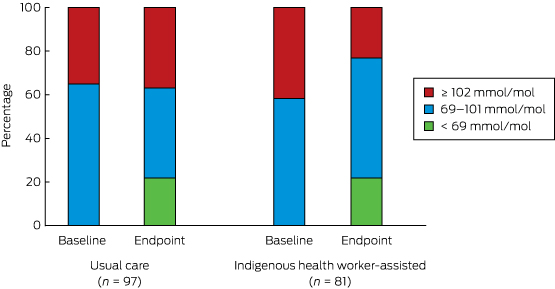
There was a statistically significant reduction in the proportion of participants with extremely poorly controlled HbA1c levels (≥ 102 mmol/mol) in the IHW-S group (from 34 to 19 people, or from 42% to 23%), but a slight increase in the UC group (34 to 36 people, or 35% to 37%; for between-group difference, P = 0.002) (Box 7). If the improvement in the IHW-S group had also been achieved by the UC group, 17 fewer people would have been expected to have had an HbA1c level ≥ 102 mmol/mol.

There were no significant changes in any of the hospitalisation categories. Rates of hospitalisations for all causes (excluding dialysis) and for type 2 diabetes-related diagnoses each increased in both groups; the small differences in favour of the IHW-S group were not statistically significant. Ambulatory care sensitive hospitalisations increased slightly in the UC group but not in the IHW-S group (P = 0.81). The only category in which the change approached statistical significance was for cases in which diabetes was the primary diagnosis: there was a differential net reduction in admission rate of 0.09 per person per year (P = 0.06) (Box 6). The effect size was small, amounting to an estimated eight fewer admissions per year among the 87 IHW participants. This suggests a possible small improvement in morbidity.

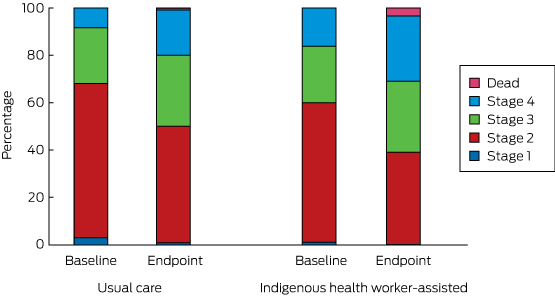
The transition between disease stages from baseline to endpoint is depicted in Box 8. The differences between the IHW-S and UC groups were not statistically significant (Markov transition matrix [Appendix], P = 0.73).

Cost-effectiveness of the intervention

Annual hospitalisation costs are reported in Box 6. There was a small reduction for most categories in the IHW-S group, but the difference only approached significance for type 2 diabetes as the primary diagnosis. Additional expenditure of just over $6700 per participant per year achieved no significant improvement in mean HbA1c levels, rate of disease progression, or quality of life, but realised a statistically sub-significant reduction in hospitalisations for those with type 2 diabetes as the primary diagnosis, yielding an estimated saving of $646 per person per year. The net intervention cost was thus just over $6000 per person per year, or $9000 for the 18-month trial. Taking into account the other significant finding, a reduction in the number of persons with very poorly controlled diabetes, this gives a cost of $42 880 for each person whose HbA1c level was reduced below the critically high level of ≥ 102 mmol/mol.

Discussion

The study examined the costs and outcomes of the GBACC model as implemented in this trial. It is one of few economic analyses of a new model of primary care for addressing poorly controlled diabetes in Indigenous people, building on a high quality cluster RCT design.

The average annual cost of just over $6700 per person for the intensive IHW-S intervention as an adjunct to regular primary care is high relative to the reported costs of primary care in Indigenous communities in Australia. One study estimated the mean annual primary care costs in 21 mainly remote Indigenous communities in north Queensland (including some of the communities involved in this trial) at $1825 per person in 2004–05, equivalent to about $2700 in 2012–13.21 This estimate included IHWs as well as medical, clinic health, nursing, managerial and clerical staff. The Australian Institute of Health and Welfare similarly reported that total primary care expenditure per Indigenous person was $2648 in 2012–13.22 Despite the higher expected primary care costs of a group with poorly controlled diabetes, $6700 per person per year is a considerable additional cost.

In terms of intervention effect, this economic study explored a range of outcomes, including mean HbA1c levels and their distribution, disease progression, quality of life, and hospitalisation. There was evidence of only a modest intervention effect, at best, in any of these measures. The only statistically significant improvement was the reduction in the proportion of patients with HbA1c levels of 102 mmol/mol or more. The difference in the reduction in number of hospitalisations for diabetes (as the primary diagnosis) was close to significant. The study was powered to detect a change in the primary outcome, a mean reduction in HbA1c levels of 12.6 mmol/mol over 18 months, not to detect changes in secondary outcomes such as hospitalisation or quality of life score.9 The effect of the intervention was assessed from the start of the trial, but there may have been a lag between its start and any impact on hospitalisation. A longer follow-up period than 18 months may have found a greater reduction in the hospitalisation rate.

Nonetheless, given the substantial additional resources that were invested, the outcomes were disappointing, with diabetes still poorly controlled in most patients, as indicated by the continued high levels of HbA1c, very high rates of disease progression, and increasing rates of hospitalisation.

There are a number of possible reasons for these outcomes. It is possible that intervening in a group of patients with less advanced disease would have been more successful. It was expected that the employed IHWs would devote 100% of their contracted work time to the trial, but other responsibilities within local health services reduced the capacity of some IHWs to support trial clients. While we adjusted for this in the costing of the trial, it will have diluted the intensity of service delivery. Combined with difficulties in recruiting and retaining staff, this meant that two communities received less than 65% of the intended level of intervention (Box 5). Any change in the IHW position will have disrupted the IHW relationship, a core element of the model. Nonetheless, good community commitment was achieved by ongoing community engagement, with the IHW model building on the Apunipima Cape York Health Council (ACYHC) family-centred approach. ACYHC was a partner in the trial, and author MW, who is a public health medical advisor with ACYHC, was a Chief Investigator in this trial.

Investment in the training and upgrading of qualifications of the IHW, as well as in providing clinical support for them is likely to generate value elsewhere in the health system and over the longer term, a likely benefit not captured by our analysis.

Data quality is a common issue in community trials. For example HbA1c data, which were extracted from participants’ clinical files, included some baseline data gathered well before the trial commenced.

It is also worth reflecting on whether the theory underpinning the trial was correct. In expanding the capacity of IHWs to provide direct and intensive support for Indigenous patients in the community, through both outreach and centre-based care, it was hoped to achieve more effective management of chronic disease because of greater cultural awareness and by improving patient engagement in self-care. While some health gains were identified, the major psychosocial and economic problems that are typical for very disadvantaged populations, and the strong relationship between these factors and chronic disease, mean that it may be necessary to address these factors more directly.23 Most of the IHW-S communities are in the bottom 2% of Queensland communities in terms of socio-economic disadvantage, indicating an extreme level of deprivation, often combined with a range of further serious adverse conditions.24 We did not have data on major life stressors (such as early death of family and friends, involvement with the criminal justice or child protection systems) that affect physical health and, probably, diabetes control; these factors may have affected the intervention and control communities differently.

A separate case study within the GBACC project found that health service providers need to review their systems of care to maximise the value of IHWs as specialist members of the multidisciplinary team.25 IHWs, who participated in regular clinical review sessions, were able to identify examples for improving self-management, which resulted in consistent positive change in HbA1c levels in patients with the poorest control. Further, IHWs could respond to the problem of patient disengagement.

Conclusions

Our results suggest that the costs of delivering the GBACC model were considerable in absolute terms but achieved only a modest effect. This suggests a need to consider how to improve the effectiveness of the program, reduce its costs, and to increase revenue (eg, through Medicare billings).

The training of IHWs and clinical support workers is generally viewed as positive, but translating it into measurable outcomes for people with poorly controlled type 2 diabetes in highly disadvantaged communities remains a challenge. A more holistic cross-agency approach may be required, one that seeks to directly address the psychosocial, pathophysiological and environmental problems that are common in highly disadvantaged populations. While the need to consider social and economic determinants is understood, there are still major gaps in service delivery. The challenge for the public health community is to devise and implement interventions based on broader understanding of the determinants of health and to test the effectiveness of such interventions.

Box 1 –
Project cost calculations for the central team and the Indigenous health workers (IHWs)


The central team

  • The central team consisted of the trial manager and the clinical support team responsible for IHW training, which included:
    • developing training materials, training delivery;
    • enhancing the quality of clinical practice through mentoring, advocacy and reflective practice with IHWs, convening IHW meetings, clinical reference group meetings, team meetings;
    • evaluation as an embedded component (data collection, data entry, conference presentations, workshops), and coordination of project activities, including chief investigator and management group meetings.
  • Costs were extracted from project financial reports for the period 1 January 2011 (commencement of the GBACC project with trial set-up) to 30 September 2013 (trial endpoint). The percentage of time allocated by the manager and the clinical support team to the trial and to the evaluation were determined by the trial manager (BS) after detailed discussion with LS and HN about the type of activities to be classed as intervention and non-intervention (evaluation and trial coordination activities).

Indigenous health workers

  • IHW salaries (including wage on-costs) in the six intervention communities were identified from project records. The proportions of their time allocated to intervention and to non-intervention activities were determined from detailed time logs kept by the IHWs. The IHW cost was calculated from their total wage costs and the percentage of time allocated to the project by each IHW.

Box 2 –
Diabetes vascular severity staging employed in this study, based on reference13


  • Type 2 diabetes with no evidence of microvascular or macrovascular risk factors.
  • Type 2 diabetes with screen-detected microvascular comorbidities and/or risk factors for macrovascular disease.
  • Type 2 diabetes with moderate microvascular or macrovascular complications.
  • Microvascular or macrovascular complications of late stage type 2 diabetes.

Box 3 –
Categorisation of admissions to hospital in this study


  • All hospitalisations.
  • Hospitalisations with principal or other diagnoses related to type 2 diabetes (ICD-10 E11 code in the principal or other diagnoses).
  • Ambulatory care sensitive (ACS) hospitalisations related to chronic disease (used by the Australian Institute of Health and Welfare to estimate ACS hospitalisations for Aboriginal and Torres Strait Islander people).15
  • The top three ACS condition categories (type 2 diabetes as principal diagnosis, cardiovascular diseases, and infections).16

Box 4 –
Baseline characteristics of the study participants

Usual care

Indigenous health worker-supported

P


Number of participants

106

87

Mean HbA1c level (SD), mmol/mol

95 (19)

99 (17)

0.12

Mean age (SD), years

47.6 (8.7)

47.5 (10.6)

0.958*

Sex (female)

70 (66%)

53 (61%)

0.533

Daily smoker

38 (36%)

34 (39%)

0.654

Current drinker

39 (37%)

36 (41%)

0.511

Mean body mass index (SD)

32.6 (6.2)(n = 43)

31.2 (6.3)(n = 44)

0.522*

Obese

28 (65%)

23 (52%)

0.280


SD = standard deviation. * Results of t test for equal means, adjusted for within-group clustering. † Results of χ2 test for equal proportions, adjusted for within-group clustering. ‡ Body mass index ≥ 30.

Box 5 –
Total cost estimates for the Getting Better at Chronic Care (GBACC) project

Total trial expenditure

Time and cost allocated to GBACC intervention


Time*

Expenditure


Central team

Clinical support team

$626 091

57%

$357 353

Management

$234 624

10%

$23 462

Operation

$440 200

23%

$102 791

Sub-total

$1 300 915

37%

$483 606

Indigenous health workers

Community A

$151 551

78%

$118 210

Community B

$151 551

64%

$96 993

Community C

$75 775

44%

$33 341

Community D

$78 028

89%

$69 445

Community E

$156 056

84%

$131 087

Community F

$78 028

94%

$73 346

Sub-total

$690 989

76%

$522 421

Total expenditure

$1 991 904

51%

$1 006 027


Source: Project financial reports. * The allocation of project team time to research and service delivery was determined by the program manager. Allocation of Indigenous health worker time to GBACC was based on time records.

Box 6 –
Summary of the incremental effectiveness analyses (change between baseline and trial end)

Usual care (n = 106)


Indigenous health worker-supported (n = 87)


Difference of differences (95% CI)

P

Baseline

Endpoint

Change*

Baseline

Endpoint

Change*


HbA1c level (SD), mmol/mol

94.7 (19.0)

89.3 (24.1)

–5.4 (n = 97)

99.0 (17.4)

88.8 (25.7)

–10.1 (n = 81)

–4.7 (–11.6 to 2.1)

0.174

AQoL-4D, mean utility score (SD)

0.80 (0.18)

0.79 (0.21)

–0.01

0.75 (0.18)

0.72 (0.28)

–0.03

–0.02 (–0.08 to 0.05)

0.623

Rate of hospitalisation (per person per year; total number of admissions in parentheses)

All causes, excluding dialysis

1.02 (172)

1.24 (176)

0.22

0.98 (135)

1.07 (124)

0.09

–0.13 (–0.68 to 0.41)

0.633

Type 2 diabetes, any diagnosis§

0.53 (88)

0.92 (128)

0.39

0.47 (64)

0.78 (88)

0.31

–0.08 (–0.20 to 0.03)

0.150

Ambulatory care sensitive

All

0.33 (58)

0.44 (60)

0.11

0.31 (45)

0.30 (36)

–0.01

–0.11 (–1.04 to 0.81)

0.811

Type 2 diabetes as principal diagnosis**

0.15 (26)

0.18 (23)

0.03

0.17 (23)

0.11 (13)

–0.06

–0.09 (–0.18 to 0.00)

0.063

Cardiovascular disease††

0.01 (1)

0.08 (12)

0.07

0.02 (3)

0.04 (5)

0.02

–0.05 (–0.13 to 0.02)

0.149

Infections‡‡

0.13 (21)

0.14 (20)

0.02

0.10 (14)

0.09 (11)

–0.01

–0.03 (–0.10 to 0.04)

0.362

Mean hospitalisation cost (per person per year)

All causes

$5438

$7421

$1982

$8010

$9866

$1856

–126 (–5024 to 4771)

0.960

Type 2 diabetes, any diagnosis§

$4248

$6582

$2335

$4921

$8595

$3674

1340 (–2724 to 5404)

0.518

Ambulatory care sensitive

All

$1665

$2132

$467

$2967

$2677

–$290

–757 (–2130 to 616)

0.280

Type 2 diabetes as principal diagnosis**

$907

$1245

$338

$1553

$1245

–$308

–646 (–1348 to 56)

0.071

Cardiovascular disease††

$23

$163

$140

$239

$383

$144

4 (–749 to 757)

0.992

Infections‡‡

$623

$609

–$14

$1040

$451

–$589

–574 (–1490 to 342)

0.219


AQoL-4D = Assessment of Quality of Life 4D score. * Only participants for whom baseline HbA1c levels were measured after 1 January 2009 and endpoint levels after 1 March 2012 were included. † Estimates for incremental difference in outcomes between usual care and IHW groups using linear multi-level models adjusted for within-community clustering. ‡ Two people in the IHW group had dialysis after the intervention commenced (starting July 2012 and March 2013); their dialysis records were excluded. § International Classification of Diseases, revision 10 (ICD-10) code in principal or any other diagnoses starting with E11. ¶ All potentially preventable hospitalisations (ICD code in principal diagnosis: D501, D508, D509, E101–E108, E110–E118, E130–E138, E140–E148, E40–E43, E550, E643, E86, G40, G41, H66, H67, I10, I119, I110, I20, I240, I248, I249, I50, J02, J03, J06, J20, J312, J41–J44, J45, J46, J47, J81, K02–K06, K08, K098, K099, K12, K13, K250–K252, K254, K255, K256, K260–K262, K264–K266, K270–K272, K274–K276, K35–K37, K522, K528, K529, L03, L04, L08, L88, L980, L983, N10–N12, N136, N390, N70, N73, N74, O15, R02 or R56).16 ** ICD-10 code in principal diagnosis starts with E11. †† ICD-10 code in principal diagnosis: I10, I110, I119, I20, I240, I248, I249, J81 or I50. ‡‡ ICD-10 code in principal diagnosis: H66, H67, J02, J03, J06, J312, L03, L04, L08, L980, L88, L983, N10–N12, N136, N390, N70, N73, N74, or R02.

Box 7 –
Distribution of HbA1c level categories at baseline and endpoint*


* Only participants for whom baseline HbA1c levels were measured after 1 January 2009 and endpoint levels after 1 March 2012 were included.

Box 8 –
Distribution of disease stages at baseline and endpoint

Identifying low-value care: the Royal Australasian College of Physicians’ EVOLVE initiative

Challenges and lessons arising from early adoption of a new approach towards determining what is good clinical practice

In March 2015, 41 medical specialties of the Royal Australasian College of Physicians (RACP) came together as part of the College’s EVOLVE initiative. The main aim of EVOLVE is to drive safer, higher-quality patient care through identifying and reducing low-value medical practices.1 In EVOLVE, “low-value” practices are defined as tests, procedures or interventions that are overused, inappropriate or of limited effectiveness (and, in extreme cases, potentially harmful). The name of the initiative reflects the dynamic and evolving nature of evidence-based medicine. EVOLVE is modelled on the Choosing Wisely initiative in the United States and similar initiatives underway in Canada, Italy and the United Kingdom.2

In EVOLVE’s first year, more than 20 specialties have completed or commenced work on lists of “top-five” low-value clinical practices in their respective fields. Here, we examine the approaches of three early adopter EVOLVE specialties — geriatric medicine, palliative medicine and rheumatology. We also share insights that have arisen so far that are relevant to the Medicare Benefits Schedule (MBS) Review Taskforce.

The EVOLVE approach

EVOLVE recognises the breadth of physicians’ practice, uniting specialties through their commitment to reducing low-value care. It is a partnership between specialty societies and the RACP. EVOLVE is clinician-led, with each specialty responsible for developing lists, engaging with its members and providing feedback to the RACP on systemic barriers to adoption of each list’s recommendations. The RACP is the umbrella body, developing common frameworks and a robust methodology, coordinating across and between specialties, connecting EVOLVE with associated initiatives such as Choosing Wisely Australia, and communicating about and advocating for high-value care.

To avoid the early mistakes of Choosing Wisely in the US, where some participating specialties identified “low-impact” practices on their lists and singled out clinical practices performed by other specialties,3 EVOLVE’s participating specialties agreed to robust principles and methods. These included:

  • Practices under consideration by each specialty should be “within or significantly impact their domain of practice”. This can be interpreted as including practices involving shared decision making with other health care specialties and those that are the subject of referral to and from other specialties. Specialties also have broad discretion to consider practices that they consider can “make a difference” in reducing low-value care (eg, rheumatologists and geriatric medicine specialists examined practices that affected people with conditions they commonly treated).

  • Practices under consideration should be either growing in use or currently commonly used. Some specialties interpreted “commonly used” as encompassing cost, not just volume (eg, rheumatologists excluded from consideration practices that were not very costly to the health care system).

  • Use of the Delphi method4 as the overarching methodology for identifying a top-five list.

The three specialties reviewed the US and Canadian Choosing Wisely lists as part of their development process, but this was not a substitute for formulating their own lists, as not every international practice is relevant to Australia. For example, performing whole-body bone scans (eg, scintigraphy) for diagnostic screening for peripheral and axial arthritis is included in the Canadian rheumatology list but is not material to Australia.

Three Delphi method case studies

EVOLVE recommends use of the Delphi method for identifying low-value care practices, in keeping with initiatives elsewhere.5 This survey-based approach derives consensus based on purposive sampling of experts in the field of interest, panellist anonymity and iterative questionnaire presentation.4

There were three subtle differences in the way the method was applied by the specialties:

  • Both geriatric medicine and palliative medicine working groups consulted their memberships early in the process to seek comment on provisionally identified practices and suggest new ones. Only after processing membership feedback and refinement of the provisional list was an evidence review conducted.

  • Both geriatric medicine and palliative medicine working groups shortlisted their identified practices by requiring respondents to assign scores to each practice based on multiple criteria. Geriatric medicine used seven criteria, while palliative medicine used three. “Strength of evidence”, “significance” and “opportunity to make a difference” were criteria common to both.

  • Rheumatology recruited additional members (including three trainees) into the working group so they could invest effort in building on the RACP’s initial evidence review. With this larger working group, they could break into smaller teams and assign to each team a practice for further research. The evidence was summarised in an online survey distributed to the broader membership, with links to a full discussion of the evidence embedded in the survey questions.

Remaining challenges

Notwithstanding EVOLVE’s established principles and methods, some challenges remain.

First, without a requirement for compulsory participation, there is an element of self-selection in participation in specialty working groups and surveys. It is unclear whether this will lead to bias in the list of practices compiled for investigation and final shortlisting.

Second, there may be a risk of limited buy-in by specialty members if survey participation rates are low or if consensus cannot be reached, potentially reducing the impact of EVOLVE lists on clinician behaviour. The rheumatology working group aims to overcome this by encouraging high survey participation and by requiring that each top-five list practice be selected by at least 70% of survey respondents, in the hope that this represents a sufficiently high threshold for buy-in.

Third, ensuring that practices being considered are commonly used or increasing in use is difficult. For some practices, regularly collected publicly available data are incomplete (eg, MBS data that do not cover all hospital-provided services or do not provide sufficiently detailed breakdowns by indication). In other cases, the judgement of survey respondents or working group members (most of whom are in active clinical practice) was relied upon to remove practices considered irrelevant because of low levels of use.

Fourth, due to the clinical expertise required to formulate EVOLVE lists, the process is specialist-dominated. Nevertheless, achieving buy-in from consumers and non-RACP clinicians is critical, as sustaining changes in clinical practice requires cooperation from these groups. This task will benefit from support from Choosing Wisely Australia, led by NPS MedicineWise, to which EVOLVE is a contributor.

Finally, implementation of the EVOLVE recommendations into practice will be the greatest challenge. A recent study of the Choosing Wisely campaign in the US found significant declines being achieved in only two of seven low-value services identified by the campaign.6 Translating the EVOLVE recommendations into clinical practice requires both consumer and clinician education and a systemic cultural shift towards high-value care. This might be achievable if there is a systematic and coordinated approach, but a substantial investment in time and support may be required to ensure that the aims of EVOLVE are achieved and are sustainable over time.

Insights relevant to the MBS Review Taskforce

The MBS Review Taskforce’s early work has focused on identifying “obsolete” MBS items.7 EVOLVE’s focus is on reducing low-value care. Use of the 23 obsolete items identified by the Taskforce will, by definition, be declining, so aiming to reduce their use will have minimal impact. By contrast, one of the EVOLVE criteria is that the practice examined is commonly used or growing in usage.

A critical EVOLVE insight is that few practices are unambiguously low value for all clinical indications, and low-value care is contextual. Hence, there will be few genuinely low-value clinical practices that could be reduced by deleting particular MBS items.

Clinical practice is more likely to be improved by ensuring tests and treatments are targeted at people with appropriate clinical indications. The following low-value practices identified by the three specialties illustrate the importance of this:

  • use of ultrasound imaging to guide glucocorticoid injections into the shoulder or lateral hip compared with non-image-guided injections (rheumatology)

  • use of antipsychotics as the first choice to treat behavioural and psychological symptoms of dementia (geriatric medicine)

  • use of oxygen therapy to treat non-hypoxic dyspnoea in the absence of anxiety and as routine treatment at the end of life (palliative medicine).

Although these three practices identify low-value applications of ultrasound imaging, antipsychotics and oxygen therapy for specific indications or groups, this does not justify withdrawing subsidies entirely from these tests and treatments, as they are valuable in other clinical contexts.

While some clinical change can be induced by restricting conditions under which particular MBS items are covered, our examples also illustrate the limits of this approach. First, there are tests and treatments that are at risk of being misused but are not funded by the MBS. Second, imposing additional restrictions on the use of MBS items does not guarantee adherence unless proof of correct indication is required.

Financial incentives have been found to have limited effectiveness in driving sustained changes in clinical practice.8 Thus, it is likely that a systems-based approach employing multiple complementary strategies is needed. Initiatives like EVOLVE, that create endorsed and recognised peer judgements on what is good clinical practice, combined with other strategies such as the current MBS Review and mechanisms to improve clinician and consumer understanding of what constitutes low-value care, are needed. Working together, such strategies may shift clinician behaviour and consumer preference towards opting for the most appropriate evidence-based tests and treatments.

[Comment] Offline: Paolo Macchiarini—science in conflict

The resignation of Anders Hamsten as Vice-Chancellor of the Karolinska Institute has accelerated a growing sense of emergency within the Swedish biomedical science community. His departure comes during the same week that the Royal Swedish Academy of Sciences issued an unprecedented statement accusing Paolo Macchiarini of “ethically indefensible working methods”. The Academy is the body that awards annual Nobel Prizes in Physics, Chemistry, and Economics (the Nobel Prize in Physiology or Medicine is awarded by the Karolinska Institute, hence the likely acute embarrassment at the tarnished reputation of one of the world’s most respected scientific centres).

[Perspectives] Charlotte Watts: from pure maths to HIV and gender-based violence

Appointed last October as Chief Scientific Adviser to the UK Government’s Department for International Development (DFID), epidemiologist Charlotte Watts of the London School of Hygiene & Tropical Medicine (LSHTM) is, by training, a pure mathematician. Indeed, her PhD from the University of Warwick was titled “stochastic stability of diffeomorphisms”. Although a background in applied maths might have offered her a natural progression into statistics and epidemiology, the relevance to health of “diffeomorphisms” is harder to discern—although not, it seems, to Anne Mills, Professor of Health Economics and Policy at LSHTM.

[Comment] Breastfeeding: a smart investment in people and in economies

If breastfeeding did not already exist, someone who invented it today would deserve a dual Nobel Prize in medicine and economics. For while “breast is best” for lifelong health, it is also excellent economics. Breastfeeding is a child’s first inoculation against death, disease, and poverty, but also their most enduring investment in physical, cognitive, and social capacity.

Cost-effectiveness of screening for bowel cancer

Increasing bowel cancer testing rates through a general practitioner-organised health care package would reduce incidence and prove cost-effective

Treating bowel cancer is expensive, and the cost is rising rapidly. In the past decade, costs have increased for treating cancers at all stages (in particular, Stages 3 and 4), largely due to increased chemotherapy options and the introduction of more effective but expensive drug regimens.1 Increased treatment costs are a stimulus for the considerable effort in the areas of prevention and early detection.

The National Bowel Cancer Screening Program (NBCSP), based on a faecal occult blood test (FOBT), was introduced in mid 2006 to people aged 55 and 65 years, and was extended in 2009 to include people aged 50 years. It is due to be further expanded to biennial testing in 2020, with gaps filled annually until then.2 This delay in full implementation is related to the perceived cost of the NBCSP as well as infrastructure and logistical difficulties.3

There are concerns with aspects of the structure of the NBCSP, such as the target age group and screening intervals.3 Incidence of bowel cancer for people aged 40 to 50 years is rising,4 and recent evidence suggests that the incidence for people aged under 40 years is also increasing.5 This is important given that people aged under 50 years are relatively productive contributors to the Australian economy.6

The screening interval in the NBCSP is 2 years but some studies have shown greater benefit from shorter screening intervals. Studies of FOBT and subsequent colonoscopy for a positive test result in patients aged 55–64 years show a reduction in mortality of 19% from biennial screening and 29% from annual screening.1 As this study was limited to patients aged 55–64 years, caution should be used when extrapolating these results to other age cohorts. A recent study emphasised that with biennial screening the NBCSP will result in 35 000 fewer deaths in the next 40 years.2

The Gut Foundation, in conjunction with Deloitte Access Economics, performed a cost-effectiveness study of screening between the ages of 40 and 70 years.7 The study is publicly available and contains details on the methodology, data and results. Three interventions were studied:

  • Biennial immunochemical FOBT (iFOBT) starting at age 40 years and ceasing at age 70 years

  • Annual iFOBT for the same period

  • Colonoscopy at age 40 years, then at age 50 years, and 5-yearly intervals thereafter until age 70 years.

The comparator was no screening and standard care when diagnosed symptomatically. The NBCSP was not used as a comparator due to a lack of publicly available data when the study was undertaken.

Three techniques were used to examine the proposed interventions:

  • Cost-effective analyses (CEAs): these compare the monetary cost of achieving a particular non-monetary objective; eg, deaths averted or life-years saved. All CEAs of the screening interventions involved an analysis of program costs, eg, costs of screening kits, and diagnostic and pathology tests; screening results, eg, number of bowel cancer cases detected (true positives), missed (false negatives) or otherwise (false positives and true negatives); bowel cancer stage incidence rates for true-positive and false-negative test results; treatment costs and health outcomes per person associated with each pathway (true positive, false positive, true negative, false negative); and overall outcomes on health care cost savings and avoidance of disability-adjusted life-years (DALYs) from earlier detection and treatment. Costs are not discounted to present values, since they are assumed to be incurred in a single year. The incremental cost-effectiveness ratios (ICERs) presented in the analysis have been calculated from the non-rounded estimates of costs and DALYs.

  • Estimated DALYs: some DALYs would be incurred as a result of annual and biennial iFOBT screening due to complications and, very rarely, as a result of deaths from colonoscopy procedures.8 However, these are outweighed by the DALYs that would be averted as a result of screening.

  • The World Health Organization recommendations: the WHO makes recommendations in relation to cost-effectiveness benchmarks. A highly cost-effective intervention is determined as costing less than the gross domestic product per capita which, in Australia, was about $60 000 per DALY averted in 2011.9

Results

The results of the cost-effectiveness modelling are presented in the Box (note that some results may not add up due to rounding). The results are expressed for:

  • Total financial costs: these include costs such as mail-outs and kits, pathology tests, general practitioner appointments, colonoscopies for participating patients with positive test results and patients in the colonoscopy intervention program, and perforations from colonoscopies. The financial costs in the model are limited to health care costs only.

  • Total financial benefits: these include benefits from better survival and cases of bowel cancer averted, and health care cost savings from earlier treatment and cases of bowel cancer averted.

  • Total costs: these include financial costs, as well as economic costs from DALYs lost, such as from patient non-participation or from false-negative test results.

  • Total benefits: these include financial benefits as well as economic benefits from fewer cases of bowel cancer and improved survival rates.

  • Net DALYs averted by the intervention.

  • ICER (societal perspective): net financial costs divided by net DALYs averted.

  • ICER (health care perspective): net financial health care costs divided by net DALYs averted.

Additional modelling results are available in the report.7 This report demonstrates that annual and biennial iFOBT and colonoscopy screening are all highly cost-effective. From a societal perspective, the annual iFOBT is the most cost-effective ($9510 per DALY averted), followed by the biennial iFOBT ($21 490) and colonoscopy ($40 978).

However, the financial costs of the annual iFOBT program are the highest ($273.8 million), followed by colonoscopy ($251.2 million) and the biennial iFOBT ($141.2 million). The annual iFOBT costs are about twice as high compared with the biennial iFOBT costs, because about twice as many tests are carried out. The colonoscopy costs are higher than the biennial iFOBT costs due to the higher costs associated with colonoscopy screening compared with screening via mail-outs.

The key to success of any screening program (eg, the NBCSP) is the uptake of the program. The participation rate needs significant improvement to reduce the incidence of bowel cancer in Australia.

A solution to this dilemma could be to include bowel cancer screening and prevention in a health care package organised by GPs. The package could be based on the annual iFOBT intervention (this includes colonoscopy for participants who receive a positive result, followed up by their GP). Based on the results of this report,7 this program has the potential to save $2.6 billion (including financial and economic savings). Note that the study did not include additional administrative, staff and system costs of GPs, eg, issuing invitations for appointments, sending reminders and following up results.

The Gut Foundation has successfully undertaken an iFOBT study via GPs in the Riverina region of New South Wales to assess the results of screening people aged ≥ 40 years. The regional population aged ≥ 40 years was encouraged to visit their GP for an iFOBT kit. From a total of 1409 kits, 203 were positive, including 51 positive test results for the 40–49 year age group.10 The positive test results included 14 cancers, 59 adenomas (including multiple adenomas) and 13 hyperplastic polyps. The study notes that the small sample size limits its impact, and that the high positivity rate may be due to the location of the study. The Gut Foundation plans to enlarge this study in the Port Macquarie area of NSW (in conjunction with the Rural Medical School at the University of New South Wales and local GPs) to identify how participation and outcomes can be improved.

While this article has focused on the cost-effectiveness of age-based population screening, it is important to note that bowel cancer has been identified as having the strongest genetic links of all the common cancers.5 Patients with a genetic predisposition to bowel cancer have a higher risk of contracting the disease across all age groups, and genetic links among young bowel cancer patients may be more common than among older bowel cancer patients.5 The cost-effectiveness of screening patients < 40 years with genetic predispositions to bowel cancer could be the subject of further research.

Bowel cancer kills an Australian every 2 hours.2 The polyp–cancer sequence and NBCSP screening data suggest many cancers could be prevented or at least diagnosed early.2 We need to act now.

Box –
Bowel cancer screening for people aged 40–70 years

Biennial iFOBT

Annual iFOBT

Colonoscopy


Total financial costs (health care only, $m)

141.2

273.8

251.2

Total financial benefits (health care only, $m)

8.7

26.1

11.4

Net financial costs (health care only, $m)

132.5

247.7

239.7

Total financial costs ($m)

141.2

273.8

251.2

Total financial benefits ($m)

38.1

124.0

54.2

Net financial costs ($m)

103.1

149.8

196.9

Total costs ($m)

182.6

353.7

541.6

Total benefits ($m)

902.8

2,907.5

1169.2

Net total benefit ($m)

720.2

2,553.9

627.7

Net DALYs averted

4798

15 756

4805

ICER (societal perspective)

21 490

9510

40 978

ICER (health care perspective)

27 620

15 719

49 894


iFOBT = immunochemical faecal occult blood test. DALY = disability-adjusted life-years. ICER = incremental cost-effectiveness ratios.

Summer reads

Australian Medicine suggests a selection of books to stimulate and entertain this summer.

Honour, Duty, Courage. By Mohamed Khadra. Penguin Random House; 249 pages; $34.99

What drives doctors with good jobs and loving families to risk life and limb by volunteering to work in some of the most hazardous places in the world? In his latest book, Sydney-based surgeon Mohamed Khadra sets out to answer that question, interviewing dozens of health professionals about their experiences working as volunteers for the Australian Army Medical Corps. He creates two fictionalised characters to recount their stories, and what emerges is a portrait of people imbued with a strong sense of duty (and a penchant for adventure) who are severely tested, physically, mentally and emotionally. Deployed to a forward surgical unit in a war-torn country that could be Rwanda, Afghanistan or Iraq, the book’s two protagonists – emergency surgeon Dr Jack Foster and anaesthetist Dr Thomas McNeal – are confronted with extremes of human depravity and deep ethical dilemma as they cope with a relentless flow of casualties from all sides of the conflict. Khadra gives a sympathetic account of the often harrowing situations such volunteers confront, and how these experiences stay with them long after the deployment ends.

The Gluten Lie: And other myths about what you eat. By Alan Levinovitz. Black Inc; 272 pages; $22.99

For his day job, Alan Levinovitz researches religious myths to find out what they mean and why they are persuasive. With this background and expertise, it is no wonder he has turned his attention to the world of food. Few areas are as prone to fads, half-digested ideas and quackery than what we eat. Flick through any newspaper or magazine, or surf the web, and you will be quickly hit with advice about the latest ‘super-food’, fad diet or poisons lurking in what you eat. In his brightly written and tightly-argued book, Levinovitz seeks to chart how some of the big myths about food of our times have emerged and taken hold, causing many into dietary contortions as they seek to confine themselves to ‘safe’ foods. He examines the science and shows how mass beliefs, in some cases verging on hysteria, about MSG, salt, sugar, grains, meat and gluten have arisen, mostly based on very thin evidence. Unlike diet books, Levinovitz doesn’t dispense advice about what you should eat, but instead asks some hard questions of those who do.

Happiness by design: change what you do, not how you think. By Paul Dolan. Penguin Random House; 235 pages; $16.

For many years, the overriding advice for those seeking to improve their happiness has been to change their mindset. Bookshelves abound with tomes advising people to think their way to a good mood. But Paul Dolan takes a refreshingly different approach. Drawing on the latest research in behavioural economics and brain science, he draws some general conclusions. Climate, for instance, does not exert a major influence on satisfaction. Wherever people live, they acclimate to the weather and get on with other aspects of their lives. He repeats the well-founded observation that volunteering tends to be correlated with a great sense of purpose, while television is associated with a sense of pleasure. So, how do individuals improve their happiness. Following the dictum that attention shapes experience, Dolan advocates identifying the things in life from which you derive joy or contentment, and seeking to make room for more of these experiences. Hardly earth-shattering advice, but powerful in its own way. As a Scientific American reviewer observes, Dolan touches on an important idea: happiness need not be pursued, simply rediscovered. In other words, sources of pleasure and purpose are all around us, if only one knows where to look.

Hospital cuts cloud reform outlook

The states are seeking to exert increasing pressure on the Federal Government over its $57 billion cut to public hospital funding amid speculation of a radical overhaul of Commonwealth-State health arrangements.

Queensland Health Minister Cameron Dick told a meeting of the nation’s health ministers last month that the Coalition Government’s decision to rip up the National Partnership Agreement on health services and reduce the indexation of Commonwealth hospital payments to population plus inflation would cut $11.8 billion from the State’s hospital system – the equivalent of 4500 doctors, nurses and allied health professionals.

This follows claims from the Victorian Government that the Commonwealth’s decision will rip $17.7 billion from its health system over the next decade, while New South Wales has figured a $16.5 billion loss, South Australia $4.6 billion, Western Australia $4.8 billion and Tasmania $1.1 billion.

Victorian health officials told a Senate inquiry the impact of the Federal Government’s cuts would be equivalent to shutting down two major hospitals and axing 23,000 elective surgery procedures every two years.

“[It] would equate to the level of service delivery of two health services the size of Melbourne Health [which operates the Royal Melbourne Hospital],” acting Victorian Health Department Secretary Kym Peake told the inquiry.

The big cuts form a challenging backdrop for discussions of reform to Federal-State relations that include proposals for Commonwealth public hospital funding to be replaced by a “hospital benefit payment” that would follow individuals, similar to Medicare.

Government discussions of changes to the private health insurance industry have included reference to option two in the Reform of the Federation Discussion Paper, which proposes a Medicare-style payment for hospital services, regardless of whether they are provided in the public or private system.

Under the arrangement, the price of hospital procedures would be set by an independent body and the Commonwealth would pay a proportion. For patients in the public system, the states would be expected to make up the difference, while in private hospitals the gap would be covered either by insurers or the patients themselves.

States would retain responsibility and operational control of public hospitals and would be able to commission services from the private sector, while the Commonwealth would discontinue the private health insurance rebate.

But the Federal Government is likely to encounter significant resistance to such a change from the states unless it comes up with more money.

The revenue raised from the GST, which is funnelled directly to the states, has been growing far more slowly than expenditure, tightening the squeeze on state budgets and their health funding.

When it was introduced in 2000, GST applied to 55 per cent of spending, but since then its share has shrunk to 47 per cent this year, and consultancy Deloitte Access Economics estimates it will apply to just 42 per cent by 2024-25.

The squeeze on funding has shown up in disappointing public hospital performance.

The latest report from the Australian Institute of Health and Welfare shows that hospitals are struggling to make headway in the face of increasing demand for emergency care.

The proportion of urgent patients receiving treatment within the recommended time fell back in 2014-15 to just 68 per cent – well short of the target of 80 per cent.

The goal for all emergency department visits to be completed within four hours, which was meant to be achieved this year, has also been missed.

The results bear out warnings made by the AMA earlier this year that the Commonwealth’s funding cuts for hospitals would undermine the delivery of care.

Launching the AMA’s annual Public Hospital Report Card, President Professor Brian Owler said the Federal Government’s cuts had created “a huge black hole in public hospital funding”.

“It’s the perfect storm for our public hospital system,” he said. “There’s no way that states and territories can even maintain their current frontline clinical services under that sort of funding regime, let alone build any capacity we actually need to address the shortfalls now.”

Health Minister Sussan Ley rejected the warnings at the time, but the latest evidence of declining performance are likely to make it increasingly difficult for the Government to win State backing for an overhaul of funding arrangements without more money on the table.

Adrian Rollins