

 more_vert
If you work in an emergency department, giving “tetanus shots” is routine. Dirty laceration, dog bite, gardening injury — we clean the wound, assess tetanus risk, check the record (or try to), and administer a booster when it is due.
But during Australia’s current pertussis (whooping cough) resurgence, many of us are still reaching for a tetanus booster that offers no protection against pertussis.
Why this matters right now
Queensland’s 2024 pertussis season was confronting: with 15 028 notifications (~16 times 2023 levels), an incidence rate approaching 268 per 100 000 people, and at least one infant death. Across Australia, notifications rose sharply through 2024-2025. Some analyses suggest this may be the largest pertussis epidemic on record nationally, with most cases occurring in older children and adults.
Adult immunity from pertussis infection and vaccination wanes over time. Many adults experience mild or atypical illness, but they remain infectious and bring the disease home. Household contacts remain a leading source of pertussis in infants, the group at highest risk of severe disease and death.
So, what can emergency departments realistically do? We can stop overlooking one of the easiest, lowest-disruption opportunities available to boost adult pertussis immunity.
Same wound care, better vaccine
In many hospitals, the default adult “tetanus shot” is dT/ADT (adult diphtheria-tetanus) vaccine. It protects against tetanus and diphtheria, but not pertussis.
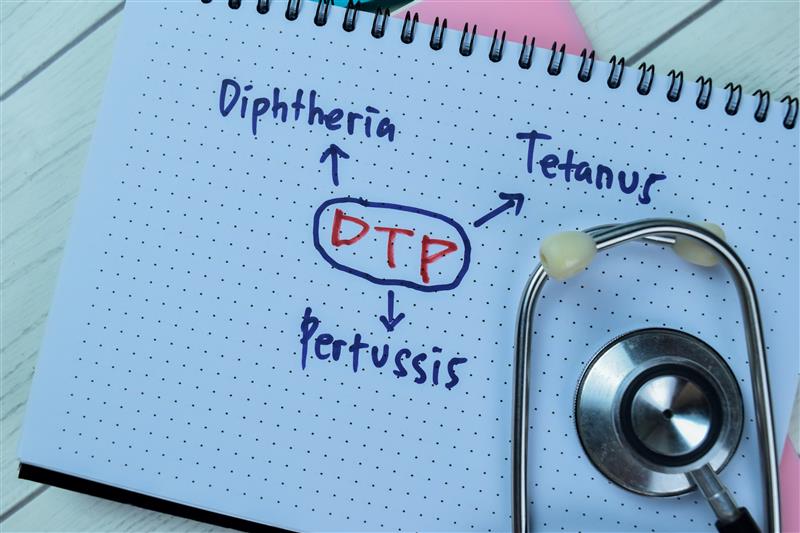
Alternatively, dTpa (reduced-antigen diphtheria-tetanus-acellular pertussis) provides equivalent protection against tetanus and diphtheria while also boosting pertussis immunity for roughly four years..
At the bedside, nothing changes. The injection (intramuscular), consent process, and observation period remain the same. The only difference is that the booster now also covers the pathogen driving today’s outbreak.
And this is not a radical departure from guidelines. The Australian Immunisation Handbook already allows (and in many scenarios recommends) a pertussis-containing vaccine for adults who need a tetanus booster for wound management. Yet routine practice has not kept pace.
A national audit by the Immunisation Foundation of Australia found that 401 of 469 Australian hospitals (over 85%) still use diphtheria–tetanus (dT/ADT) as the routine adult tetanus booster rather than dTpa.
In Queensland alone, Queensland Health Central Pharmacy distributed 72 980 doses of dT/ADT to Hospital and Health Services in 2024. That is 72 980 tetanus boosters — and 72 980 missed chances to curb pertussis transmission.
Emergency departments are the perfect touchpoint
Most adults do not think about boosters until an injury forces the issue. For many, particularly those without a regular GP, the emergency department is often the first (and sometimes only) place where adult vaccination status is reviewed.
In a local audit of two Queensland emergency departments, more than 93% of adult tetanus-containing vaccines were given in emergency departments rather than primary care. In 2024, all 3,603 adult tetanus boosters delivered at those sites were dT/ADT, not dTpa.That’s a snapshot, but it highlights how entrenched “dT/ADT by default” is in routine practice.
At the same time, adult vaccination coverage against pertussis remains low. Primary care and Australian Immunisation register data show that in 2023 only about 20.8% of people aged 50 years and over were up to date for pertussis coverage. Even among those up to date for tetanus, around one third had received dT/ADT instead of dTpa.
So, when an adult presents with a tetanus-prone wound, the choice between dT/ADT and dTpa becomes a public health decision. It is one of the rare chances to close an immunity gap without requiring a new appointment or workflow — just by using the appropriate vaccine.
What would it take to flip the default?
The objections tend to sound familiar: cost, supply, and “patients won’t want another vaccine”. In practice, they are usually manageable.
Cost: A current price difference of up to $6-11 used between dT/ADT and dTpa (depending on which dTpa vaccine used) is modest when weighted against the community economic burden of a pertussis infection ($473-909), health care presentation, or a vulnerable infant being exposed at home. Preliminary modelling from two Queensland emergency department (presented at the 2025 ACEM Annual Scientific Meeting) suggests that replacing dT/ADT with dTpa for adult tetanus boosters could prevent thousands of pertussis cases over 4-8 years and generate more than $1 million in community savings.
Supply and workflow: Both vaccines already sit within hospital systems. Switching the default is largely about pharmacy stocking, protocol wording, and electronic order sets — not additional staff, training, or time required.
Patient acceptance: Emergency departments studies suggest many patients, especially those without reliable primary care, accept opportunistic vaccination when it is offered as routine care. If dTpa is framed as “the standard tetanus booster we use now”, most patients simply see it as sensible practice.
Strategies to make the shift to dTpa include:
- Clear State/Territory guidance naming dTpa as first-line for adult tetanus prophylaxis in Emergency Departments wound care (with clear exceptions where needed);
- Updated local protocols and electronic prompts, so dTpa becomes the default choice. Reliable pharmacy supply of dTPa (which make dT/ADT the exception, not the norm); and
- Brief, targeted education to ensure clinicians feel confident with indications and documentation.
None of this requires a new clinic or campaign. It just requires an organisational intent and decision to change.
A small change with big spillover benefits
No single intervention will “fix” pertussis. The vaccine is not perfect, immunity wanes, transmission is complex, and epidemic cycles will continue. But right now, with notifications high, it is difficult to justify continuing to give a “tetanus shot” that ignores pertussis when a near-identical alternative is available.
Every dT/ADT dose given in emergency departments is a missed opportunity to strengthen pertussis protection — not just for the individual patient, but for their household, and for the infants and older adults most at risk. Switching the default to dTpa does not add time, staffing, or complexity to wound care — it simply ensures that the care we already provide delivers more.
A/Prof Michael D. Nissen is Director of Research and Senior Staff Specialist in Infectious Diseases at The Prince Charles Hospital and Royal Brisbane and Women’s Hospital, Metro North Health, Queensland.
Dr Faye Jordan is Research Director and Senior Staff Specialist in Emergency Medicine at The Prince Charles Hospital, Metro North Health, Queensland.
Dr Polash Adhikari is a Senior Staff Specialist in Emergency Medicine at The Prince Charles Hospital, Metro North Health, Queensland.
Dr Megan Young is a Public Health Physician with the Metro North Public Health Unit.
Dr Alec Henderson is a Research Fellow at the UQ Centre for Clinical Research, The University of Queensland.
Dr Sebastian Vernal is a Research Fellow at the UQ Centre for Clinical Research, Faculty of Health, Medicine and Behavioural Sciences, The University of Queensland.
A/Prof. Luis Furuya-Kanamori is Theme Leader for Infectious Diseases at the UQ Centre for Clinical Research, Faculty of Health, Medicine and Behavioural Sciences.